
Sizing
What Size Dumpster Do I Need in Arlington, TX? A Sizing Guide
Roll-off sizing for Arlington and Tarrant County: what each of the five sizes is actually for here, why wet clay spoil, broken concrete and shingle tear-off are weight jobs rather than volume jobs, and why the city's two cubic yard kerbside cap sends these jobs to a container.
Most sizing calls start with a project name. "We're having piers put in Thursday, what size do I need?" There is no answer in a project name. In Arlington the container is sized by what the debris weighs long before it is sized by the room it takes up, and what this market produces — wet clay out of a pier hole, broken flatwork, stripped composition shingle — is heavier per cubic yard than anything a national sizing calculator was written around.
Andre Reyes started ARX Dumpster Rental with one truck and four cans in 2012 and still answers the phone. The yard is at 1200 N Commercial Blvd in south Arlington, off the I-20 corridor. The most common mistake we see is a homeowner ordering a 30 yard for a job that reaches its legal payload in the bottom two feet of a 10.
Weight sets the size, volume only sets the shape
Every roll-off has two ceilings: the space inside the box, and what the truck can legally lift off your driveway and carry out to I-20 or I-30. Most of the country runs out of space first, which is why most sizing advice online is written in cubic yards. North Texas is the other case. Three loads hit payload while the box still looks half empty:
- Wet Blackland clay excavation spoil. Pier holes and perimeter tunnelling leave a pile that looks modest on the lawn and weighs like nothing else we haul off a residential drive. Clay that has sat through a week of autumn rain is heavier again, because it has taken on water and swelled.
- Broken concrete and flatwork. Driveway sections, patio slabs, sidewalk, mow strips, pier access holes cut through a slab. Concrete nests as it settles, so the box keeps taking weight after it stops looking hungry.
- Asphalt shingle tear-off. A re-roof is a weight job wearing a volume costume, and it is the most misjudged load in this city.
All three load the same way: flat and low, spread across the floor, never mounded. Mounding puts the container over payload while the driver is still on his way, and the load cannot be safely tarped for the landfill run. So the standing rule here is the reverse of what most calculators say: when two sizes both look plausible on a dense load, take the smaller box and plan a swap. A container over payload cannot legally leave your driveway.
Arlington is also not one soil: Tarrant County exposes fifteen surface formations in north–south bands, so a hole on the west side gives you something different from a hole on the east. On the Houston Black clay the USDA puts numbers on it — 40 to 60 percent clay, cracks up to four inches wide and twelve inches deep, open 90 to 150 days a year. That soil moves, and it holds water. More in our notes on foundation repair and concrete debris in Arlington.
Two cubic yards a week is why the phone rings
Arlington's kerbside service is genuinely decent and genuinely small. Collection is contracted to Republic Services, everything lands on one day, and the household allowances run roughly like this:
- About two cubic yards a week of bundled brush, yard waste and bagged leaves combined — limbs cut to four-foot lengths, branch diameter under six inches, bundles capped at 50 pounds.
- About two cubic yards a week of bulky household items, at washer and dryer scale.
Then the sentence that defines this business. The City of Arlington states plainly that "construction debris and roofing shingles cannot be collected curbside; contractors bear responsibility for hauling away these materials", though residents may haul shingles to the landfill themselves.
Put a real job against it. One bathroom stripped to studs is eight to twelve cubic yards — five or six weeks of your household's entire bulky allowance, and it does not qualify anyway, because remodel debris is construction debris. A re-roof is worse: a twenty square composition roof strips off well past a dozen cubic yards in an afternoon, all of it on the exclusion list. That gap is why roll-offs exist here. Household details sit with the City of Arlington.
The five sizes and the Arlington jobs they suit
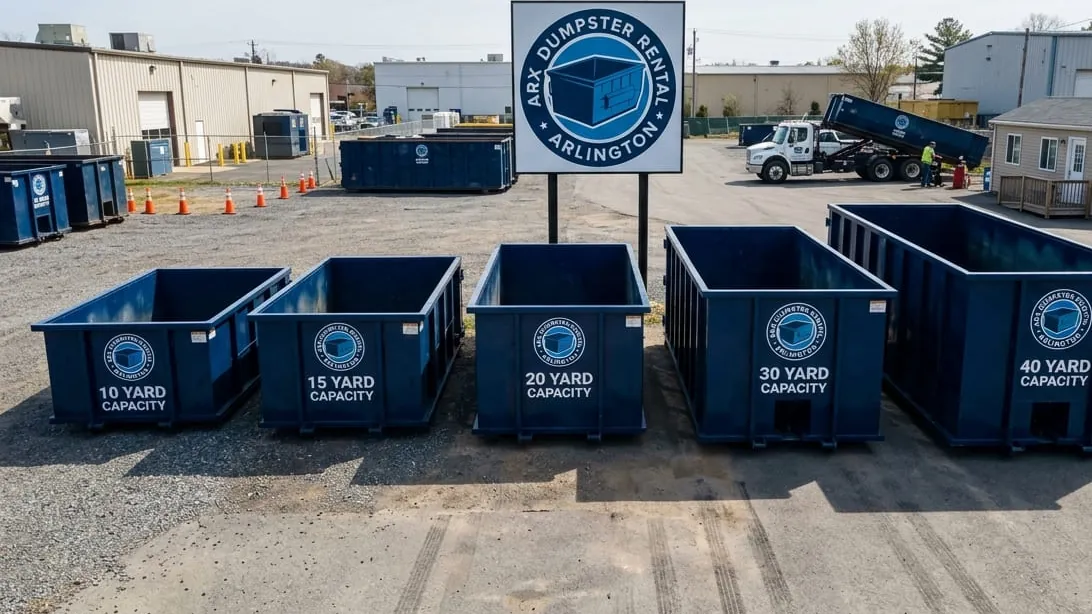
We run 10, 15, 20, 30 and 40 yard containers, and all five sit with their working dimensions on the dumpster sizes page.
10 yard: the heavy specialist
In many markets the 10 is an afterthought. Here it works every week: clay spoil, broken concrete and flatwork, and small tear-offs. The low walls stop you loading past what the truck can hoist. A 10 yard container loaded flat with wet clay or broken slab is full when a passer-by would call it a third full.
15 yard: one room, or one turnover
The workhorse for single-room work and rental turnover: one bathroom or one kitchen out of a Woodland West house, or a two-bedroom unit after a tenant leaves. Arlington has a large renter population and a university with more than 42,000 students in the middle of the city, so turnover runs on its own calendar. A 15 yard container also fits driveways a 20 will not.
20 yard: the default
If Arlington has a standard box, this is it: garage, attic and shed clear-outs, multi-room remodels, most single-layer composition re-roofs loaded flat, storm limb wood and fence panels after a spring line. A 20 yard container takes mixed household and construction debris without payload becoming a live question — unless you put concrete or wet clay in it, in which case go back to the 10.
30 yard: whole property, or a builder on site
A 30 yard container is for whole-property work: an estate clear where the house, garage and shed all empty, a full interior gut, or builder work on an infill lot. The taller walls suit bulk, not weight. A 30 filled with anything dense stays where it is.
40 yard: bulky and light only
The 40 yard container has a real place and a narrow one: fence panels after a wind event, a patio cover coming down, siding and trim off a re-side, furniture out of a rental refresh near the Entertainment District. Nothing dense belongs in it.
Sizing table by job
| The job | Typical volume | Weight character | Container |
|---|---|---|---|
| Pier holes and tunnelling spoil, wet clay | 3–6 cu yd | Extreme for its volume | 10, loaded flat and low |
| Driveway, patio or sidewalk breakout | 5–8 cu yd | Extreme, keep it clean | 10, dedicated concrete load |
| One bathroom stripped to studs | 6–10 cu yd | Moderate; tile and cast iron add up | 15 |
| Garage, attic and shed clear-out | 15–20 cu yd | Light, bulky, slow to load | 20 |
| Single-layer composition re-roof | 12–16 cu yd | Heavy — size by squares | 20 loaded flat, or pulls |
| Two-layer tear-off down to deck | 22–30 cu yd | Very heavy | Staged pulls, sized by weight |
| Whole-property clear plus outbuilding | 25–35 cu yd | Light to moderate | 30 |
| Fencing, patio cover, siding, furniture | 28–40 cu yd | Very light for its bulk | 30 or 40 |
Those volumes are loose material as it comes out of the house. On the concrete, clay and shingle rows the container is deliberately smaller than the volume suggests. Those loads go out under concrete and heavy debris, kept clean and unmixed.
Sizing by the era of the house
The population curve tells you most of what is inside a house before you walk in. Arlington had 7,692 people in 1950 and 44,775 by 1960, so essentially the whole city was built from the mid-1950s onward.
- Pre-1950, the small original core around downtown, Abram and Center. Under 8,000 people lived in all of Arlington then. These are the pier-and-beam houses: modest footprints, often with a detached garage holding more than the house. Size by the outbuildings.
- 1950s and 60s, central Arlington around downtown and UTA. The explosive decade, and the start of the slab era. Compact three-bedroom plans, single-car drives, original kitchens already remodelled once. A 15 or a 20 usually does it.
- 1970s and 80s: Woodland West, Fielder, Rush Creek, the Bowen corridor. The largest single cohort of Arlington's housing, and where most of our work is. Second re-roofs, original baths coming out, mature trees over the drive. Multi-room remodels are 20 yard jobs; whole clear-outs are 30s.
- 1990s and 2000s, south and far north Arlington. Bigger houses, bigger lots, more storage, and associations with something to say about where a container sits.
- 2010s onward: Viridian in north Arlington, and infill elsewhere. Builder punch-out, offcuts, packaging. High volume, low weight, usually room for a 30.
There is no basement, and a calculator does not know that
Basements are very rare in North Texas, for three unmysterious reasons. Expansive clay swelling against a below-grade wall turns that wall into an engineering problem rather than a poured detail. No frost line here forces a deep excavation, so the hole is pure added cost rather than nearly free. And buyers price on dollars per square foot of space above ground.
That matters for sizing. A national cleanout calculator quietly assumes a lower level holding thirty years of boxes and a workbench. Subtract that floor. Here the volume comes from the garage, the attic, the patio, the side yard and the shed — real, but less. A calculator built around a basement will oversize an Arlington cleanout, often by a full container size. The attic is the exception: North Texas summers turn stored tape, vinyl, photo albums and upholstered furniture into trash rather than donations.
Roof sizing: squares, layers and weight
This is asphalt and composition shingle country. The Texas legislature wrote a statute protecting a homeowner's right to install wind- and hail-resistant shingles over an association's objection, and legislatures do not pass shingle statutes for metal-roof markets. Texas leads the nation for hail and DFW sits in the highest-risk tier, so the re-roof cycle here runs on claims as much as on age.
Roofers count in squares — one square is 100 square feet of roof. Two numbers size the container: how many squares, and how many layers are coming off. A 2,000 square foot house with normal pitch, hips and overhang works out near twenty-two squares, and single-layer composition off that roof is a comfortable 20 yard load if it goes in flat. Two layers is close to double the weight, and doubling weight on a box already limited by payload means pulls, not a bigger container. Add underlayment, nails, flashing and any rotted decking. The arithmetic is worked square by square in our roofing tear-off dumpster size guide, and the containers sit under roofing dumpster rental.
Will it fit where you want it
Sizing is half the job. A box that will not fit the approach is the wrong size whatever the volume says. The truck needs:
- Roughly 60 feet of straight approach to set a 20 or larger. The truck backs in and rolls the container off the rails; it cannot pivot a box into place.
- About 10.5 feet of width the whole way — gate posts, brick mailbox pillars, a truck parked opposite on a 1960s street.
- Twenty feet or more of overhead clearance for the hoist arm. This is the one that catches people here, because the obstruction is a mature post oak, live oak, cedar elm or pecan that has grown over the drive since the house was new. A limb that clears a delivery van will not clear a raised hoist.
- Protection boards under the rails and wheels on every set. Concrete drives chip at the rails; asphalt takes an impression and keeps it.
The calendar changes the answer
Spring severe weather is the demand season. April and May are the peak across the NWS Fort Worth area, with a real and frequently missed secondary peak in October. After a hail line crosses Arlington, containers across the metroplex are spoken for within about two days, and sizing becomes scheduling: a box you can actually get, swapped twice, beats a perfectly sized one that arrives in eleven days. Warnings come from the National Weather Service.
Summer heat is the operational limit. DFW averages 20.2 days a year at or above 100°F, with July and August normal highs both near 96°F. Loading slows: a crew that would fill a 20 in a morning takes until mid-afternoon. Size for that pace, or plan the swap so nobody stands next to a full box waiting on a truck.
Tell us what the material actually is — not "debris", but clay spoil, broken concrete, shingle, cabinetry, fence panels — roughly how much, and what the approach passes. Then the rule that fixes most of what goes wrong: on a dense load go smaller and swap; on a bulky light load go bigger the first time. That is the opposite of what a national calculator tells an Arlington homeowner, and it is the difference between a container that leaves on schedule and one sitting in your driveway over payload.
ARX Dumpster Rental has sized jobs out of the yard on N Commercial Blvd since 2012, from the pre-1950 core downtown through the seventies and eighties streets off Fielder and Bowen out to Viridian. Tell Andre what you are tearing out and where it needs to sit. Call (817) 404-4864 and he will size it before a truck leaves the yard.
Questions this guide did not answer? Call (817) 404-4864. We would rather spend two minutes on the phone than have you order the wrong container.