
Storm Cleanup
Hail and Storm Damage Cleanup in Arlington: What to Do With the Debris
April and May bring roughly 55 percent of North Texas tornadoes, and October is a real second peak. Here is what a hail line, a wind event, a flood or a hard freeze leaves on an Arlington property, how each pile loads, and why capacity runs out inside a week.
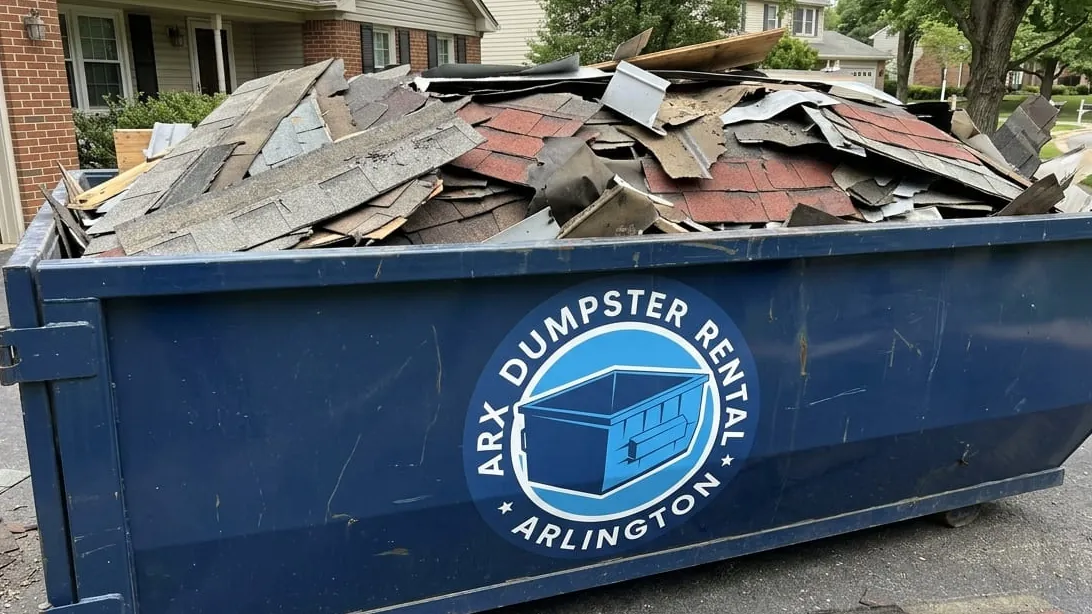
A hail line crosses Arlington in about fifteen minutes and leaves work that runs for months. The sound is what people remember, then the quiet, then the walk around the house past fence panels lying flat and gutters full of shingle granules. This is a guide to what comes off a property here after severe weather, how each pile loads, and the order to do things in.
The season here, with the actual numbers
North Texas severe weather is a spring story with an autumn footnote that most people miss. The National Weather Service Fort Worth county warning area has logged tornadoes since 1950, and the monthly shape is clear: April 555 tornadoes, roughly seven a year. May 525, roughly seven a year. October 145, roughly two a year. April and May together account for about 55 percent of every tornado in the record. Across the whole period the region averages 26 tornadoes a year.
That October figure is the one worth carrying around. The secondary autumn peak is real and it is routinely missed by writers who assume a single spring peak, which is how homeowners who have already put the patio furniture away get caught.
The core hail window is March through June. Large hail, damaging winds, flooding and tornadoes occur in the metroplex in nearly every year on record. Not every year brings a surveyed tornado to one city, but every year brings something.
Texas leads the nation for hail
The hail statistic gets exaggerated constantly, so state it carefully. In 2025 Texas recorded 902 hail events, ahead of Kansas at 375 and Oklahoma at 369, and more than 235,000 Texas homes took hail damage. The honest framing is that Texas leads the nation for hail, and the DFW Metroplex sits in the highest-risk tier within it. Anyone claiming a specific metro is the number one hail city in America is quoting a ranking that does not say what they think it says.
What matters is the chain that follows. Hail damages composition shingle across a wide swathe of the metroplex on one afternoon, adjusters write the same neighbourhood in the same week, roofers book out, and the tear-off debris hits the kerb where the city will not take it. Read the roofing tear-off dumpster size guide before ordering.
The storms this area is measured by
3 April 2012, the Kennedale-Arlington EF-2
This is the local anchor, and it is worth being precise about it because it is the storm people here still describe by street name. On 3 April 2012 an EF-2 tornado with estimated winds to 135 mph tracked 4.6 miles at a maximum width of 150 yards. It began east of North Little Road and north of Swiney Hiett Road in Kennedale, moved north-northeast across US-287 and I-20, and ended just east of Lake Arlington.
Damage was surveyed at Sublett Road and Fawn Meadow Trail, along the I-20 corridor between Kelly Elliott Road and Green Oaks Boulevard, at Haverford Drive and Thorncliffe Drive, and on Chaperito Trail — ordinary south Arlington and Kennedale housing: slab-on-grade, composition shingle, wood fencing, mature post oak and cedar elm over the drives.
Date it honestly: that was 2012, not last spring. It is the reference point because it is the one fully documented Arlington-area tornado of that intensity, not because it is recent.
24 to 29 April 2026, a regional outbreak
A multi-day severe episode crossed North Texas in late April 2026: an EF-3 near Mineral Wells in Parker County with winds to 145 mph, softball-size hail near Godley on 28 April, teacup-size hail across northeast Dallas, Rockwall and Hunt counties on 27 April, and supercells along the dryline across the middle of the DFW Metroplex.
Read that as a regional event. The summary does not name Tarrant County or Arlington, and we are not going to pretend otherwise. What it shows is the pattern: one dryline setup, several days, hail of wildly different sizes in places forty miles apart.
5 May 1995, the Fort Worth Mayfest hailstorm
The canonical North Texas hail catastrophe, and the event older contractors still measure everything against. Cited here for what it established rather than for figures: one metroplex hailstorm can put a whole roofing market into a multi-year backlog.
Winter is the other half of the story
February 2021, Winter Storm Uri. DFW hit a minimum of -2°F on 16 February, stayed 139 consecutive hours below freezing, and took 5.0 inches of snow between 14 and 17 February.
30 January to 1 February 2023. 1.3 inches of sleet fell at DFW on 31 January, breaking the date record set in 1985. The airport spent 88 consecutive hours at or below freezing, ice accretion reached half an inch, and there were 3,544 flight cancellations at DFW.
Against a normal of 29.2 nights a year at or below freezing, those are outliers of a kind that arrives every few years. The shape of the problem here is short-duration ice and hard freeze, not snow. It bursts supply lines in attics and exterior walls, splits limbs off live oak and cedar elm under ice load, tears gutters and roof edges, and disrupts delivery for days rather than months.
What each kind of storm actually puts in a container
Hail
Hail damage is a weight job. The bulk of it is shingle tear-off — the old layer or layers, felt, drip edge, ridge, boots and nails — and a container of shingle reaches payload while it still looks half empty. Around it comes the second tier: fence panels, window and porch screens, dented gutters and downspouts, torn patio covers and shade structures. Those are volume with no weight, which is why we ask what is in the pile before sizing. A roofing container loaded low and level is a different order than a mixed storm load.
Straight-line wind and tornado
Wind damage is structural, and the debris reflects it: framing lumber, siding, fencing, roof decking and insulation, mixed with whatever came out of the garage and the yard. Bulky, awkward and full of nails.
The second half of a wind job is wood. Arlington's canopy is post oak, live oak, red oak, cedar elm, pecan and hackberry, and a mature one of any of those over a driveway produces more limb wood than people estimate. Whole-tree material runs as a clean separate load, kept out of the construction pile from the first hour. That is a yard waste load.
Flooding
Flooding here is generally a fast, local, street-and-creek problem rather than a slow regional rise, but the interior debris is the same everywhere: soaked drywall cut above the waterline, carpet, pad, subfloor and cabinetry. The surprise is weight. Wet gypsum and saturated pad are several times the dry weight, and a container that would suit a dry gut becomes a payload problem. That is a demolition debris load sized for weight.
Ice and hard freeze
A burst pipe puts the wall back open. The debris is interior demolition — drywall, flooring, trim, cabinets and insulation — from wherever the water ran, plus split limb wood outside. Two loads, or one container in two stages, because the wood belongs with the green stream.
| Event | What comes off the property | How it loads | Route |
|---|---|---|---|
| Hail line | Shingle tear-off, felt, fence panels, screens, gutters, patio covers | At payload while the box looks half full | Roofing container, loaded low |
| Wind or tornado | Framing, siding, decking, insulation, fencing | Bulky, light, full of nails | Mixed construction load |
| Downed hardwood | Trunk sections and limb wood | Heavy for its volume; will not compact | Clean green load, separate |
| Flooding | Drywall, carpet, pad, subfloor, cabinetry | Several times its dry weight | Demolition load, sized for weight |
| Ice and burst pipe | Drywall, flooring, trim, cabinets, split limbs | Moderate weight, two streams | Interior load plus a green pull |
Sorting matters more after a storm than at any other time
On an ordinary remodel, mixing is often efficient. After a storm it is not: a storm hands you three genuinely different materials at once, and how they get piled is decided in the first hour whether you decide it or not.
Vegetative debris rides as its own clean load and goes to the Arlington Landfill, which converts green waste into mulch. Be clear about why, because there is bad information on this point: Texas has no statewide yard-waste landfill ban. Unlike South Carolina, Florida and several northeastern states, nothing in Texas rule keeps limb wood out of a landfill cell. We run it clean and separate by choice, for cost and for the mulch pathway, not because a statute requires it.
Three streams, kept apart from the beginning:
- Clean vegetative debris — trunk sections, limb wood, brush. No fence hardware, no shingle, no wire.
- Shingle and roofing — the tear-off, felt and flashing, on its own because it is the weight.
- Mixed construction and contents — framing, siding, drywall, insulation, fencing, screens, ruined furniture and the general junk and debris a storm creates.
Our Arlington recycling and disposal guide covers where each stream ends up, and the size comparison shows what the 10, 15, 20, 30 and 40 yard boxes hold. Nothing hazardous goes in any of them, and no asbestos-containing material from a pre-1980 roof or ceiling, ever.
Where people get stuck: the kerbside limits
Arlington runs a real yard waste and bulky programme, and after a storm it is immediately inadequate. Here is what the City of Arlington allows:
- Brush cut to 4-foot lengths, bundled, large end toward the kerb
- Branch diameter not exceeding 6 inches
- Bundles limited to 50 pounds
- Roughly 2 cubic yards per household per week of bundled brush, yard waste and bagged leaves combined
- 2 cubic yards per week of bulky household items, the city describes the scale as washer or dryer sized
Then the line that decides the question. The city states plainly that construction debris and roofing shingles cannot be collected curbside, and that contractors bear responsibility for hauling those materials away. Residents may take shingles to the landfill themselves.
After a hail line that allowance is meaningless. A tear-off is many times a week of bulky capacity and sits in the category the city will not take at any volume. One mature cedar elm across a fence exceeds the 2 cubic yard brush cap several times over, and a 20-inch trunk section is not going into a 50-pound bundle under a 6-inch diameter limit. That gap is why roll-offs exist here, and our guide to what size dumpster you need in Arlington works through it.
Insurance sequencing, in the order that actually works
Photograph everything before you move a single piece of it. Wide shots from four sides, then close work: bruised shingle with the granule loss, the dented gutter, hail splatter on the fence rail, the fence panel with its posts still in the ground, the ceiling stain under the puncture. From the ground, before any cleanup.
Keep the adjuster's timeline in mind, not just the roofer's. After a metroplex-wide event the adjuster may be days or weeks out, and the file that settles quickly is the one that does not need a second visit.
Do not put anything in the container that the adjuster still needs to see. This is the most common expensive mistake after a storm, because material that is already gone is difficult to write. Keep it separate and out of the weather, and load it only once it is released. A container sitting an extra two days is cheaper than a disputed claim.
Book early, and mean it
After a metroplex-wide hail event, every roofer, adjuster, tree crew and roll-off container in North Texas is spoken for inside a week. That is arithmetic rather than a sales line: one line of storms damages tens of thousands of properties in the same afternoon and every one of those households picks up the phone that evening. Container inventory is finite, and the honest answer on day five is often a date, not a truck.
So call before the property is ready and ask about swap-outs, because a storm job is usually two or three loads. Shingle, limb wood and wet drywall are three different sizing problems, and knowing which you have changes the box we send.
After the storm
Photograph it, leave the insurance material until it is released, sort the green from the shingle from the mixed, and get on a schedule before the rest of the metroplex does.
ARX Dumpster Rental has run roll-offs out of the yard at 1200 N Commercial Blvd in south Arlington since 2012, the same spring the Kennedale tornado came up across I-20. Andre Reyes started with one truck and four cans and still answers the phone. Tell him it is storm work and what came off the house, and he will size it for weight rather than volume. Call (817) 404-4864 or use our contact page.
Questions this guide did not answer? Call (817) 404-4864. We would rather spend two minutes on the phone than have you order the wrong container.