
Recycling
Recycling and Disposal in Arlington, TX: Where Everything Actually Goes
An Arlington operator's map of where material actually goes, from the yard-waste ban that does not exist in Texas and the real 30 TAC prohibition list to the Fort Worth collection centre, the kerbside caps and the Arlington Landfill at Mosier Valley.
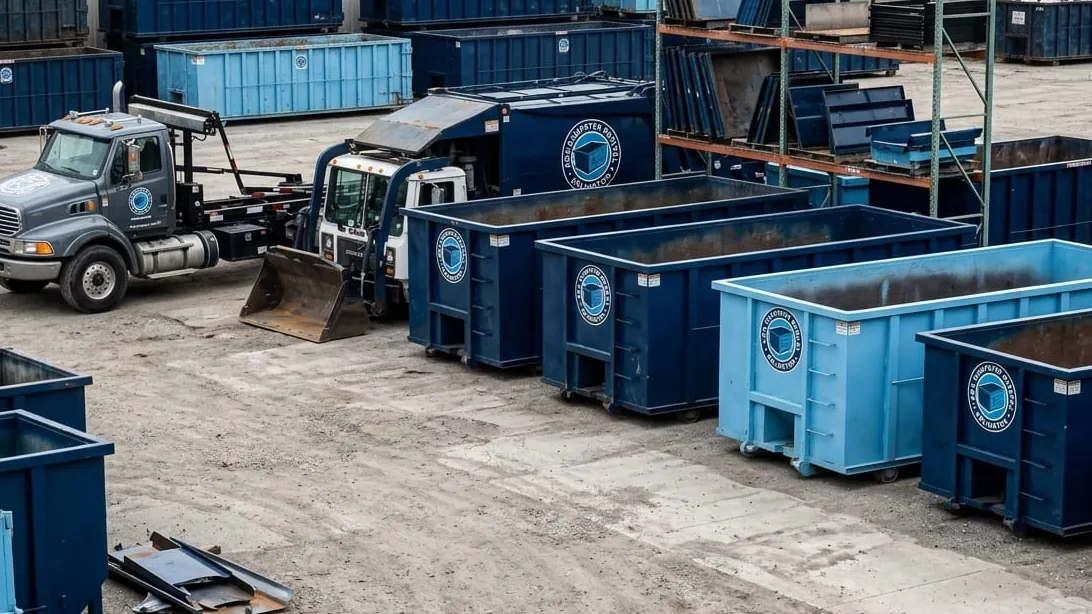
People want to know where it goes. A 20 yard box leaves a driveway off Bowen Road and that is usually the last anyone thinks about it. In Arlington it does not all go to one place. A load can split across four destinations depending on how it was stacked, some of it has a free home nearby, and a short list of material cannot ride in a container at all. This is the working map, because most national guides get Texas wrong and one of those errors costs money.
Start with the correction: Texas has no yard-waste landfill ban
Search for yard waste disposal and you will be told, confidently, that state law keeps grass, leaves and brush out of the landfill and that composting or mulching is the only route. That is true in South Carolina, in Florida, and across much of the northeast. It is not true in Texas, and it is not true in Arlington.
Three lines of evidence say so. First, 30 TAC §330.15(e) enumerates what a municipal solid waste site may not accept, and yard waste is not among them. Second, Texas is absent from the national roster of ban states. Third, and most directly, the City of Arlington says in its own guidance that bagged leaves picked up at the kerb are not recyclable and go straight to the landfill. No city publishes that sentence if a state ban exists.
There is a nuance underneath the correction. No ban does not mean no pathway. Texas encourages diversion — the TCEQ maintains a composting and mulching route, and the Arlington Landfill converts green waste into mulch. So we still run limb wood, stumps and brush as a clean separate load — a choice, because it handles better and cheaper than the same material buried in mixed debris, not a statutory requirement. Our yard waste removal page covers staging it.
What Texas actually does ban, precisely
The real list is short, specific and more conditional than people expect. Two of the six entries are routinely stated wrong.
| Material | Rule | What it actually says |
|---|---|---|
| Lead-acid batteries | §330.15(e)(1) | Banned outright. Retailers take them on a core exchange |
| Used motor oil from DIY work | §330.15(e)(2) | Banned outright. Draining your own pan does not exempt it |
| Used oil filters | §330.15(e)(3) | A separate, distinct ban that almost every guide omits. The filter is banned on its own terms, not just the oil inside |
| Whole used or scrap tires | §330.15(e)(4) | Whole tires, banned unless processed first — a ban on the casing, not on tires as a material. The Arlington Landfill accepts tires from residents |
| CFC-containing appliances | §330.15(e)(5) | Conditional, not banned. Refrigerant must be recovered under 40 CFR Part 82; once evacuated, the shell is disposable metal |
| Bulk or non-containerised liquid waste | §330.15(e)(6) | Banned. Loose liquid in any volume, including a half-full drum tipped into a box |
Three things Texans are wrongly told are banned
Electronics. No landfill ban, only manufacturer take-back. Texas Recycles Computers came from HB 2714 in 2007, and Texas Recycles TVs does the equivalent for televisions. The limit matters: the computer programme covers personal and home-business equipment only, so an office, a school district or a non-profit clearing forty machines is outside it and must arrange a recycler. The Arlington Landfill accepts electronic waste, usually the simplest household answer.
Mattresses. No Texas mattress law, no state fee, no ban. The Mattress Recycling Council operates in California, Connecticut, Oregon and Rhode Island only. A guide pointing you at the state mattress programme was written somewhere else. In Texas a mattress is ordinary municipal solid waste.
Paint. Not banned either, but it carries the worst advice aimed at Texas readers.
PaintCare does not operate in Texas
Ask any search engine about leftover paint and you will be told to hand the cans back through PaintCare at a hardware or paint retailer, funded by a stewardship fee you supposedly paid at the register. PaintCare runs in twelve states plus the District of Columbia, and Texas is not one of them. There is no stewardship fee on paint bought in Arlington and no network here to take it back, so six half-used gallons carried into a paint store gets a polite no.
What Texans do splits by chemistry. Latex and water-based paint may be dried out and put in the regular trash — lid off in a ventilated place, or stir in cat litter, sawdust or a hardener until it is solid through, then bin it lid-off so it can be seen to be dry. Oil-based paint, stain, varnish and solvent must go to a household hazardous waste facility, never into a roll-off.
Household hazardous waste: Arlington uses Fort Worth's facility
Arlington has no permanent household hazardous waste facility of its own. It does not need one, because it is a participating city at Fort Worth's. The Fort Worth Environmental Collection Center, 6400 Bridge Street, Fort Worth, TX 76112. Thursday and Friday 11am to 7pm, Saturday 9am to 3pm, closed Sunday through Wednesday. 817-392-1234. Arlington residents go free, no voucher, once per month per household, on a driver's licence — the preferred proof — or a water bill. Details come from the City of Fort Worth and are worth checking first.
It takes automotive fluids with a 10 gallon limit, cleaning chemicals, cooking oil, lawn, garden and pool chemicals, light bulbs, paint and paint supplies, pesticides and chemical batteries. A Help-Yourself-Shelf puts usable leftovers out free.
Two limits decide whether it is your answer. Propane is not confirmed on either city's published list and is commonly restricted, so call 817-392-1234 before loading a tank into the car. Then the harder one: the centre is for residential waste only, and commercial, business or industrial waste cannot be accepted. A painter with fifteen gallons of leftover enamel from an Arlington job cannot use it, and neither can a property manager clearing a maintenance shed. That lines up with how the landfill treats contractors, which is why commercial work here needs a disposal plan before the job starts.
Arlington also runs periodic mobile collection events, first-come first-served with limited capacity, posted on the city's garbage and recycling pages. For dates, call 817-459-6778.
The jurisdiction trap that catches people every year
An Arlington mailing address is not the same as being in Arlington. Pantego and Dalworthington Gardens are separate incorporated towns, enclaves inside the Arlington street grid, each its own municipality with its own waste and hazardous waste rules.
The gap is not theoretical. An Arlington resident goes to the Fort Worth centre free with no voucher. A Dalworthington Gardens resident needs a voucher and pays $47. Same street grid, different rules. Check which city bills you for water before planning the trip, and before assuming the rest of this page applies to you.
Where the load itself goes: the Arlington Landfill
Arlington Landfill, 800 Mosier Valley Road, Euless. Monday to Saturday, 7:00am to 4:30pm, closed Sunday. (817) 354-2305.
Three things about it get reported wrong. It is one facility, not two. You will see it written up as the City of Arlington Landfill and separately as the Republic Services Arlington landfill, as though a municipal site and a private site both existed. There is one: the City of Arlington owns it, and Republic Waste Services of Texas, Ltd., trading as Arlington Landfill, operates it under lease. Second, it has a Euless address and is not inside Arlington city limits, though TCEQ lists it as City of Arlington Landfill, Tarrant County. Drivers new to the route lose forty minutes looking in Arlington. Third, it is a recovery site: it takes green waste and mulches it, plus concrete, metal, electronic waste and tires, and runs 246 landfill gas wells. It does not take household hazardous waste. That goes to Bridge Street.
The resident programme is useful and pointedly limited. Arlington residents get three free drop-offs a year, discounted rates after. You must be an Arlington Water Utilities account holder or authorised user living permanently in Arlington, homeowners only. It is non-transferrable, and the scale house wants a valid Texas driver licence or Texas ID. Accepted material is bulky residential: carpet, appliances, tree limbs, tires, fence panels.
Then the exclusion that decides most of our phone calls. Contractors, landlords and apartment tenants pay regular landfill fees and get no free visits. A rental turnover, a flip, a roofer, a remodeller — all outside the programme. Rates are not ours to quote; call (817) 354-2305.
What the kerb will and will not take
Since the February 2024 cart conversion Arlington collects from automated carts rather than bags. Households get a 95-gallon cart as standard, a 65-gallon on request, no bill difference between sizes, and extra carts at a city-published $6.89 per month. Trash, recycling, yard waste and bulky items all come on one single collection day. Carts stay out of public view, and enforcement runs from an orange "Oops" tag to a notice of violation to a citation carrying a minimum $37 fine.
Brush and yard waste have a real programme with hard limits. Limbs cut to 4-foot lengths and bundled, large end toward the kerb, diameter not over 6 inches, bundles capped at 50 pounds. The allowance runs roughly 2 cubic yards per household per week for bundled brush, loose yard waste and bagged leaves combined. Bulky items get their own 2 cubic yards a week, which the city describes as washer or dryer sized.
And then the line that explains why this company exists, from the city's own guidance: construction debris and roofing shingles cannot be collected kerbside, and contractors bear responsibility for hauling away these materials, though residents may take shingles to the landfill themselves. Not capped — not collected, at any volume. A re-roof or a kitchen gut passes two cubic yards in the first hour, and that gap is the roll-off market here. Our guide to what can go in a dumpster in Tarrant County and the page on construction debris disposal cover it, and the size guide covers which box fits. For anything else the kerb refuses, the Arlington Action Center is on 817-459-6777, and the rules sit with the City of Arlington.
What we separate, and why it is worth your time
Disposal is charged by weight, so anything pulled before the box goes on the truck is worth pulling. Five streams matter on a normal job.
- Clean concrete and masonry — broken drive, patio, footings, pier spoil, a slab section. With no drywall or dirt clods in it, it has a different destination than mixed debris. Mixed, it is just heavy trash, which is why we run a separate heavy debris container.
- Scrap metal — water heater, attic ductwork, fence posts, chain link, railing, gutter, an old range. Pull it before loading, because once it is under shingles nobody is going back for it.
- Cardboard — bales cleanly if it stays dry, and on a move-out it is a real share of the volume.
- Clean untreated wood — framing offcuts, pallets, fence pickets without hardware. Grinds for mulch.
- Vegetative debris — limb wood after a spring line or an October storm, hedge removal, stumps. Keep plastic out of it; paper bags can stay.
Before any of that, pull the salvage. Cabinets still square, solid-core doors, working appliances, light fixtures, tools and yard equipment out of a garage. On a whole-house clearout that is often a trailer of material nobody needed to pay for by weight; the home cleanout checklist covers staging a house so it does not end up in one pile.
The short version
Hazardous material, oil, filters, batteries, pesticides and oil-based paint into the car for a Thursday to Saturday run to Bridge Street, once a month, free for Arlington residents. Latex paint dried out and binned. Scrap metal set aside. Green waste as its own unbagged load for the mulch pile at Mosier Valley. Furniture and appliances out with the bulky allowance if two cubic yards covers it. Everything the kerb will not take — construction debris, shingles, tile, flooring, cabinets, fencing, masonry — into a container, heavy separated from light. That turns one buried load into four or five clean streams. Where the sorting is the work, that is what junk removal is for.
ARX Dumpster Rental has hauled out of the yard at 1200 N Commercial Blvd in south Arlington since 2012. Andre Reyes started with one truck and four cans and still answers the phone, and he will say plainly when a city programme beats a box on the drive. When it does not, call (817) 404-4864 or use our contact page.
Questions this guide did not answer? Call (817) 404-4864. We would rather spend two minutes on the phone than have you order the wrong container.