
Construction
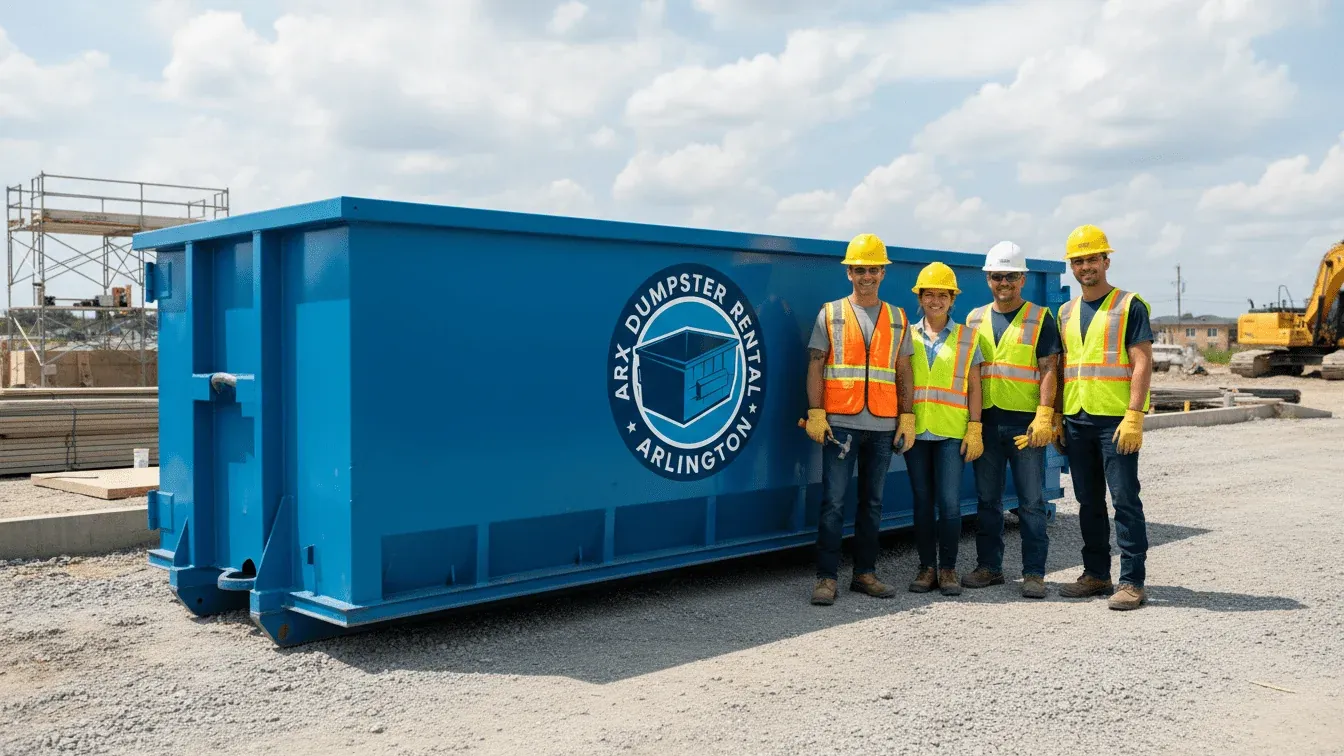
Construction Dumpster Rental in Arlington, Texas
Jobsite roll-offs and next-day swaps for builders, remodelers and general contractors across Tarrant County. The kerb takes none of this, and contractors get no free landfill visits, so the container is the disposal plan.
The City of Arlington is explicit about this one, and it is the reason the phone rings. Construction debris and roofing shingles cannot be collected at the kerb, and contractors bear responsibility for hauling those materials away. The household allowance is roughly two cubic yards of bulky items a week on a single collection day, which is a washer and a dryer, not a bathroom gut. The distance between that allowance and any real remodel, addition or tear-out is the whole job description of a jobsite roll-off in this city, and it does not shrink for a small project. One room of tile and cabinets clears the weekly cap before lunch on the first day.
The economics do not soften for a contractor either. Arlington residents get three free drop-offs a year at the Arlington Landfill, but the programme is limited to Water Utilities account holders with a permanent residence in the city, homeowners only and non-transferrable. Contractors, landlords and anyone doing contracted work pay regular fees and get no free visits. The landfill itself is one facility, not two — owned by the City of Arlington and operated under long-term lease by Republic at 800 Mosier Valley Road with a Euless address, open Monday to Saturday 7:00am to 4:30pm and closed Sunday, with hand-unloaded loads at the scales by 4:00pm on weekdays. It is on (817) 354-2305.
What actually governs a jobsite here is timing. Digging — pier holes, a pool demolition, a fence line, a driveway tear-out — needs a Texas811 notification two working days ahead. Demolition or renovation notification goes to the Texas Department of State Health Services, not the environmental agency, at least ten working days out. And if the building is 50 years or older, the Landmark Preservation Commission has to see it before a demolition permit is released. Those clocks run alongside your container schedule, so we plan the drops around them. The Tarrant County disposal guide lays it out.
Jobsite Work We Run Containers For
Whole-House Remodel
Cabinets, flooring, tile, drywall, trim and fixtures out of a 1970s or 1980s brick ranch. Mixed density, so the swap cycle matters more than the first box size.
Kitchen And Bath Gut
Tile, the mortar bed, cast iron, cabinets and the wall behind them. It fills on weight while the room still looks half finished, which is why a small can wins.
Room Addition And Slab Work
Form lumber, breakout concrete, excavation spoil and the sections of exterior wall that came out to tie the addition in. Two clean loads beat one mixed one.
Foundation Repair Spoil
Wet Blackland clay from pier holes and perimeter tunnelling is very heavy for its volume and is a genuine payload problem. It rides in a small box and gets swapped.
Interior Demolition For Tenant Work
Partition, ceiling grid, flooring, fixtures and old shopfitting on a rent commencement clock. Overnight and early access is normal on Collins and Cooper.
New Build Punch-Out
Offcuts, packaging, board ends, brick banding and pallets on infill lots and in the newer north Arlington subdivisions. Bulky, light and constant.
Fence, Deck And Flatwork
Cedar panels and posts, deck boards, and broken drive and patio concrete. Concrete goes in its own clean load rather than mixed with the timber.
Storm Repair Rebuild
After a spring hail line or an autumn wind event: decking, siding, fence, soffit and interior repair where water got in. Weeks of work, not days.
Sizing Jobsite Containers And Swaps
The 20 yard covers most remodel work and it is the box that still sits on a residential drive without blocking the garage. Move to a 30 yard for a whole-house gut, an addition or a small teardown where framing and roof material go in together, and to a 40 yard only where the material is light and bulky — insulation, packaging, cabinetry, ductwork — because a large box full of dense material will be at payload long before it is full. Anything heavy runs the other way: concrete, brick, tile and wet clay spoil belong in a 10 yard on a swap cycle, kept clean and separate. On a running job the number that matters is not the box size but how fast we can turn it, and we schedule swaps against your trades rather than after the fact.
20 Yard Dumpster
Garage, attic and shed clear-outs, multi-room renovations, deck and fence tear-offs.
View this size →30yd³30 Yard Dumpster
Whole-property clears, new construction, additions and large remodels.
View this size →40yd³40 Yard Dumpster
Bulky light debris only: fencing, patio covers, siding, insulation, furniture, fit-outs.
View this size →Permits, Notifications And The Arlington Clock
Three timelines decide whether a jobsite runs smoothly here, and none is the container. First, excavation. Texas811 notification is required no earlier than the fourteenth day and no later than the forty-eighth hour before you break ground, excluding weekends and holidays — two working days in practice. Setting a box on a driveway does not trigger it; pier holes and a pool demolition do. Second, asbestos. Notification goes to DSHS under the Texas Asbestos Health Protection Rules at least ten working days before demolition or abatement, and it is required even when no asbestos is present. We cannot accept asbestos-containing material in any container, ever. Third, the street: a container affecting a lane needs a Temporary Traffic Control Permit, three business days minimum, $500 a day for non-compliance. One more worth knowing: a long-sitting pile of materials can draw a nuisance complaint, but the ordinance exempts materials stored in a workmanlike manner in conjunction with an active building permit, so the permit is the defence.
Not sure this is the right service? Describe the job on the phone and we will point you at the right container even if it is a different service page. Call (817) 404-4864.
Get a flat quote
Two minutes on the phone gets you a size, a price and a delivery slot. No forms.
(817) 404-4864Recommended sizes
How it works
Construction Dumpster Rental in four steps
- 1
Call us
Tell us the project, your address and when you want it. Two minutes on the phone and you have a flat price.
- 2
We deliver
Our driver walks the drop, lays protection boards and sets the container exactly where you want it.
- 3
You load it
Take your time within your rental window. Keep it level with the top rail and we handle the rest.
- 4
We haul it
Call or text when you are done. We pull it, sort what can be recovered and dispose of the rest properly.
Construction Dumpster Rental FAQs
Can a contractor leave construction debris at the kerb in Arlington?
No. The city states directly that construction debris and roofing shingles cannot be collected at the kerb and that contractors bear responsibility for hauling those materials away. The weekly household allowance is about two cubic yards of bulky items and about two cubic yards of bundled brush and yard waste, on one collection day, with bundles capped at four-foot lengths, six inches of branch diameter and 50 pounds. That is a domestic allowance, not a disposal plan for a project. Residents may take shingles to the landfill themselves, but a contractor pays full rate. If you need to check what the city will and will not take, the Action Center is on 817-459-6777.
Do contractors get the three free landfill drop-offs?
No. The free visits belong to Arlington homeowners who hold an Arlington Water Utilities account and have a permanent residence in the city, and they are non-transferrable with a Texas driver licence or ID checked at the scale house. Contractors, landlords and apartment tenants pay regular fees with no free visits, which means a flip, a rental turnover or any contracted work is outside the programme. Budget the disposal as a line item from the start rather than assuming a free route exists. Rates and current hours come from the landfill directly on (817) 354-2305.
Who gets the asbestos notification in Texas, and when?
The Texas Department of State Health Services, not the environmental agency — this is the most commonly botched fact about working in Texas, because in most states it runs the other way. Notification is due at least ten working days before demolition or abatement starts, which is about two calendar weeks and longer across a holiday, under the Texas Asbestos Health Protection Rules in 25 TAC Chapter 296. It is required before demolishing a building even when a survey finds nothing; a clean survey changes what the notice says, not whether you file it. A single private residence or an apartment building of four units or fewer is exempt. The DSHS programme is on 512-834-6747, and DSHS publishes the forms.
We are demolishing an older Arlington building. What will slow it down?
The 50-year review. If the building is 50 years or older, its age cannot be determined, or it sits in the Landmark Preservation Overlay, the Landmark Preservation Commission has to review the demolition. The commission generally meets the second Thursday of the month, applications are due at least nine business days before, and while the commission cannot deny a demolition permit it can extend the Historic Stay by 45 additional days. Given how much of central and north Arlington was built by the mid-1970s, that trigger catches a great deal. Stack it with the ten working day DSHS notification and a pre-1976 teardown can need weeks of lead time before a machine moves. The permit itself needs an aerial site plan showing the limits of demolition, proof of an asbestos survey on commercial work, and a SWPPP over one acre.
Do we have to call before digging for pier holes?
Yes. Texas811 is the notification centre and the statute requires notice no earlier than the fourteenth day and no later than the forty-eighth hour before excavation, excluding Saturdays, Sundays and legal holidays, which works out at two working days. First violation penalties run $500 to $1,000, rising for repeats inside a year. It applies to pier holes on a foundation repair, a pool demolition, a fence line or a driveway tear-out, and it does not apply to setting a container on a driveway. The spoil that comes back out of those holes is wet clay and is heavier per yard than almost anything else on the site, so size that container by weight and plan on swaps.
More services
Other things we haul
Residential Dumpster Rental
Driveway placement for garage, attic, shed and side-yard cleanouts and remodels.
Learn more →Commercial Dumpster Rental
Scheduled and on-call containers for retail, restaurants, offices and property managers.
Learn more →Roofing Dumpster Rental
Weight-rated cans sized by squares and layers for asphalt shingle tear-offs.
Learn more →Roll-Off Dumpster Rental
10, 15, 20, 30 and 40 yard roll-offs across Arlington and Tarrant County.
Learn more →Same-Day Dumpster Rental
Call before the cut-off and we can usually get a container to you this afternoon.
Learn more →Junk Removal Dumpsters
Clear a garage, attic, shed or side yard on your own schedule.
Learn more →Estate Cleanout Dumpsters
Discreet, patient container service for families clearing a lifelong home.
Learn more →Demolition Debris Removal
Containers and fast swaps for sheds, fencing, patio covers and interior gut-outs.
Learn more →Concrete & Heavy Debris
Dedicated heavy cans for broken concrete, brick, flatwork and wet clay spoil.
Learn more →Yard Waste & Brush Removal
Separate clean loads for storm limb wood the 2 cubic yard kerbside cap will not take.
Learn more →Where we deliver
Construction Dumpster Rental across Tarrant County and the DFW Metroplex
Same service, same flat rates, every town below. Pick yours for local placement and permit notes.
Talk to a real person
Need construction dumpster rental in Arlington?
Tell us what you are clearing out and we will tell you the right size and the flat price to put it in your driveway. No forms, no waiting on an email — just call and we will sort it out in a couple of minutes.
Serving Arlington, Tarrant County and the DFW Metroplex · Mon–Fri 6am–5:30pm, Sat 7am–2pm