
Heavy Debris
Concrete and Heavy Debris Dumpsters in Arlington
The weight service in this market. Wet clay pier spoil, broken slab, flatwork, brick and shingle tear-off all reach payload while the box still looks half empty, so these loads go flat, low and in a smaller container.
Foundation work drives this service, and the soil is why. The USDA soil survey describes Houston Black, the Texas state soil, as 40 to 60 percent clay with high shrink-swell, cracking 0.5 to 4 inches wide and 12 inches or more deep, with those cracks open 90 to 150 cumulative days a year. Cracks four inches wide and a foot deep, open three to five months of the year, is the whole story of North Texas foundations in one line, and it is a federal soil figure rather than anybody's marketing. Add a wet spring, a dry July and August and a wet autumn, and it is the annual cycle rather than any single event that moves a slab.
Where you stand in Arlington changes the answer, which is why blanket claims about Blackland clay do not hold up. Tarrant County exposes its formations in north-south bands, so under the city you find Eagle Ford shale weathering to expansive clay, Woodbine sandstone with clay and shale that behaves sandier, comparatively stable Austin Chalk along the eastern escarpment toward Grand Prairie, and Trinity River and Village Creek alluvium through the centre. Soil conditions change materially over a few miles here. That is exactly why foundation performance varies street to street rather than neighbourhood to neighbourhood.
What that puts in a container is heavy and predictable. Excavation spoil out of pier holes and perimeter tunnels, and wet Blackland clay is very heavy for its volume. Broken concrete from slab breakouts and interior pier access holes. Flatwork and landscaping removed to get at the perimeter. Interior finish debris where the repair triggers remediation. All of it loads flat and low, never mounded, and a 10 yard is at payload well before it looks full. See foundation repair and concrete debris.
Heavy Material We Take In Arlington
Foundation Pier Spoil
Wet clay out of pier holes and perimeter tunnels. It looks like a modest heap and weighs like a much bigger one, so this is the load that decides the container size.
Broken Slab And Concrete
Slab breakouts, interior pier access holes and old footings. Dense, sharp and awkward, and it goes in its own part-filled box rather than the mixed demolition container.
Driveway And Flatwork Tear-Out
Drives, walks, patios and porch slabs off the 1960s to 1980s stock. Broken into manageable pieces it loads tidily, and the box is low enough to walk a barrow up to.
Brick, Block And Mortar
Brick veneer, chimney work, retaining block and the mortar that comes with it. Arlington is a brick city, so this turns up on far more jobs than people expect.
Asphalt Shingle Tear-Off
Texas leads the nation for hail and DFW sits in the highest-risk tier, so re-roofs are constant. The city will not take shingles at the kerb at any volume.
Tile, Mortar Bed And Backer
Floor tile set in a mortar bed, backer board and thinset. It comes up in sheets and pieces, and it puts more weight in the box than the room area suggests.
Landscape Stone And Edging
Stone edging, retaining pieces and old borders pulled out for perimeter access during a foundation repair. Heavy, and easier to load flat than to stack.
Mixed Loads Kept Separate
When a job makes both heavy and light debris we set two boxes. The Arlington Landfill separates concrete, and a clean heavy load is the cheaper way to move it.
Why The Box Gets Smaller, Not Bigger
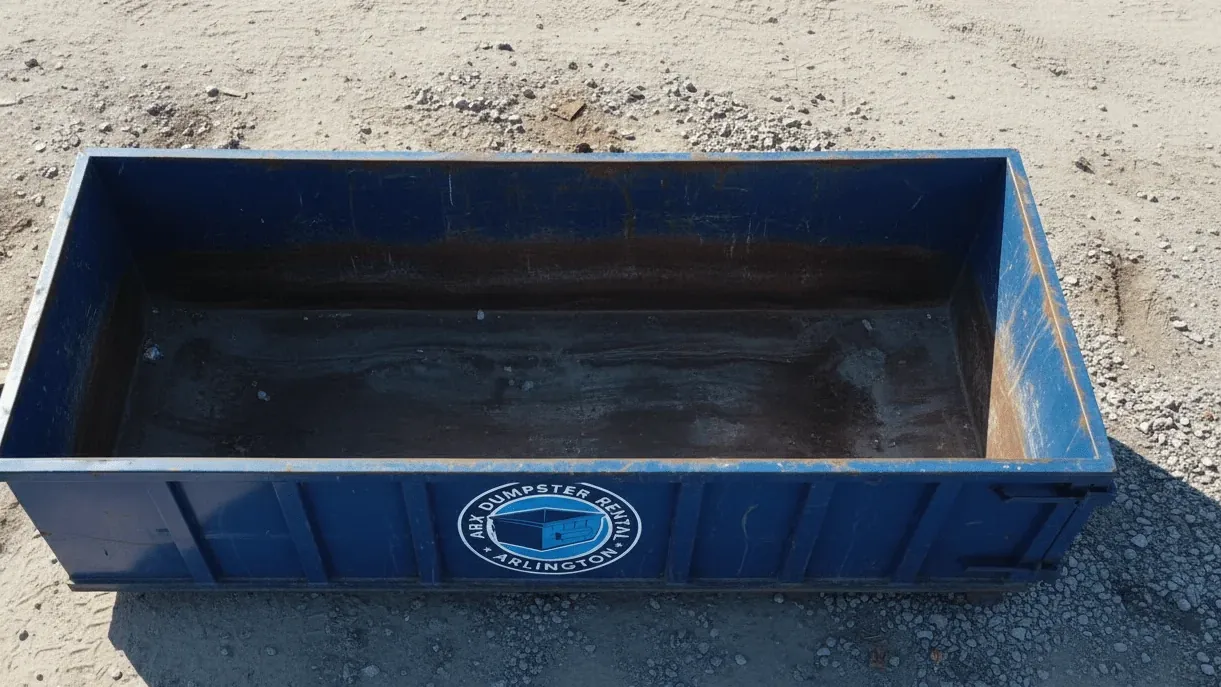
Heavy material is sized by weight, and the honest answer is nearly always the 10 yard. Low sides, a short body, and it reaches payload while it still looks a third full — that is not a container being undersized, it is the material being dense. Pier spoil, broken slab, brick and tile all behave the same way. A 15 yard works when the load is mixed, so concrete and clay come out alongside lighter demolition debris and the average drops. A 20 yard is about as far as this goes, and only where the heavy fraction is a small part of a bigger job. Ordering a 30 or 40 for concrete simply buys length you cannot legally fill. If the volume is genuinely large, the answer is more loads in a small box, not one big box, so tell us the material before the size.
10 Yard Dumpster
Broken concrete, brick, flatwork, wet clay spoil and shingle — weight fills it long before volume does.
View this size →15yd³15 Yard Dumpster
Single-room remodels, small tear-offs and rental turnovers near campus.
View this size →20yd³20 Yard Dumpster
Garage, attic and shed clear-outs, multi-room renovations, deck and fence tear-offs.
View this size →Loading Flat, Driveways And Separation
Three rules keep a heavy load legal and keep your drive intact. First, load flat and low. Level with the rails, never mounded, spread across the floor of the box rather than heaped over the axle end — a mounded heavy load cannot be tarped, cannot be lifted safely, and is the single most common reason a pickup gets refused. Second, protection boards go under the rails on every set, and we photograph the surface before steel touches it. A loaded concrete box is the heaviest thing that will ever sit on a residential driveway, and the driveways on the 1960s and 1970s brick ranch stock are original, short and thin. Third, keep the stream clean. The Arlington Landfill separates concrete, so a box of pure broken concrete moves differently from a mixed one, and running two boxes usually costs less than contaminating one. If the job involves digging — pier footings, a fence line, a drive tear-out — Texas811 gets two working days notice before the machine arrives. Landfill enquiries: (817) 354-2305.
Not sure this is the right service? Describe the job on the phone and we will point you at the right container even if it is a different service page. Call (817) 404-4864.
Get a flat quote
Two minutes on the phone gets you a size, a price and a delivery slot. No forms.
(817) 404-4864Recommended sizes
How it works
Concrete & Heavy Debris in four steps
- 1
Call us
Tell us the project, your address and when you want it. Two minutes on the phone and you have a flat price.
- 2
We deliver
Our driver walks the drop, lays protection boards and sets the container exactly where you want it.
- 3
You load it
Take your time within your rental window. Keep it level with the top rail and we handle the rest.
- 4
We haul it
Call or text when you are done. We pull it, sort what can be recovered and dispose of the rest properly.
Concrete & Heavy Debris FAQs
Why is wet clay so much heavier than it looks?
Because of what it is. The USDA soil survey puts Houston Black, the Texas state soil, at 40 to 60 percent clay with high shrink-swell potential. Wet, that clay holds a great deal of water and comes out of a pier hole as dense, sticky material that fills a container by weight long before it fills it by volume. A pile of spoil that looks like half a small box can be a full legal payload. That is why foundation jobs get a 10 yard and a swap, and why we ask what the material is before we ask how much of it there is.
What size do I need to tear out a driveway or a patio?
A 10 yard, and probably more than one of them. Broken concrete is dense enough that a low, short container reaches payload while it still looks a third full, and a bigger box only buys you length you cannot legally fill. Break the slab into pieces you can lift, load them flat across the floor of the box rather than heaping them at one end, and call for a swap when the load sits level with the rails. If landscaping, edging or old footings are coming out at the same time, tell us, because those add weight faster than they add volume.
Why does my neighbour have foundation trouble and I do not?
Almost certainly the ground. Tarrant County exposes its formations in north-south bands, and under Arlington you can find Eagle Ford shale weathering to strongly expansive clay, Woodbine sandstone with clay and shale that behaves quite differently, Austin Chalk along the eastern escarpment toward Grand Prairie, and river and creek alluvium through the north and centre. Soil conditions change materially over a few miles, which is why performance varies street to street. Anyone telling you Arlington is uniformly Blackland clay is giving you half the picture.
Can I mix concrete in with the rest of the demolition debris?
Better not to. Two boxes almost always work out cheaper than one contaminated load. The Arlington Landfill separates concrete, so a clean heavy load and a clean mixed load each go where they should, while a mixed box that is mostly concrete reaches payload early and wastes the volume you paid for. On a job producing both, we set a small heavy box for the slab, brick and pier spoil and a bigger one for framing, cabinets and drywall. It also loads faster, because nobody is picking through a pile deciding what goes where.
Can you take asphalt shingle tear-off?
Yes, and shingles belong in this category rather than the household one, because a tear-off is a weight job. It also has to go somewhere: the City of Arlington states that construction debris and roofing shingles cannot be collected kerbside and that contractors are responsible for hauling them away, though residents may take shingles to the landfill directly. Contractors pay regular landfill rates and get none of the free resident visits. Texas leads the nation for hail and DFW sits in the highest-risk tier, so this is steady work here. See roofing containers.
More services
Other things we haul
Residential Dumpster Rental
Driveway placement for garage, attic, shed and side-yard cleanouts and remodels.
Learn more →Commercial Dumpster Rental
Scheduled and on-call containers for retail, restaurants, offices and property managers.
Learn more →Construction Dumpster Rental
Jobsite roll-offs and next-day swap-outs for builders, remodelers and GCs.
Learn more →Roofing Dumpster Rental
Weight-rated cans sized by squares and layers for asphalt shingle tear-offs.
Learn more →Roll-Off Dumpster Rental
10, 15, 20, 30 and 40 yard roll-offs across Arlington and Tarrant County.
Learn more →Same-Day Dumpster Rental
Call before the cut-off and we can usually get a container to you this afternoon.
Learn more →Junk Removal Dumpsters
Clear a garage, attic, shed or side yard on your own schedule.
Learn more →Estate Cleanout Dumpsters
Discreet, patient container service for families clearing a lifelong home.
Learn more →Demolition Debris Removal
Containers and fast swaps for sheds, fencing, patio covers and interior gut-outs.
Learn more →Yard Waste & Brush Removal
Separate clean loads for storm limb wood the 2 cubic yard kerbside cap will not take.
Learn more →Where we deliver
Concrete & Heavy Debris across Tarrant County and the DFW Metroplex
Same service, same flat rates, every town below. Pick yours for local placement and permit notes.
Talk to a real person
Need concrete & heavy debris in Arlington?
Tell us what you are clearing out and we will tell you the right size and the flat price to put it in your driveway. No forms, no waiting on an email — just call and we will sort it out in a couple of minutes.
Serving Arlington, Tarrant County and the DFW Metroplex · Mon–Fri 6am–5:30pm, Sat 7am–2pm