
Construction
Construction Debris Disposal in Tarrant County: A Contractor's Guide
Construction debris and roofing shingles cannot be collected curbside in Arlington, and contractors are excluded from both the free landfill drop-offs and the Fort Worth ECC. How to separate streams, and what the DSHS clock and the 50-year LPC review do to a schedule.
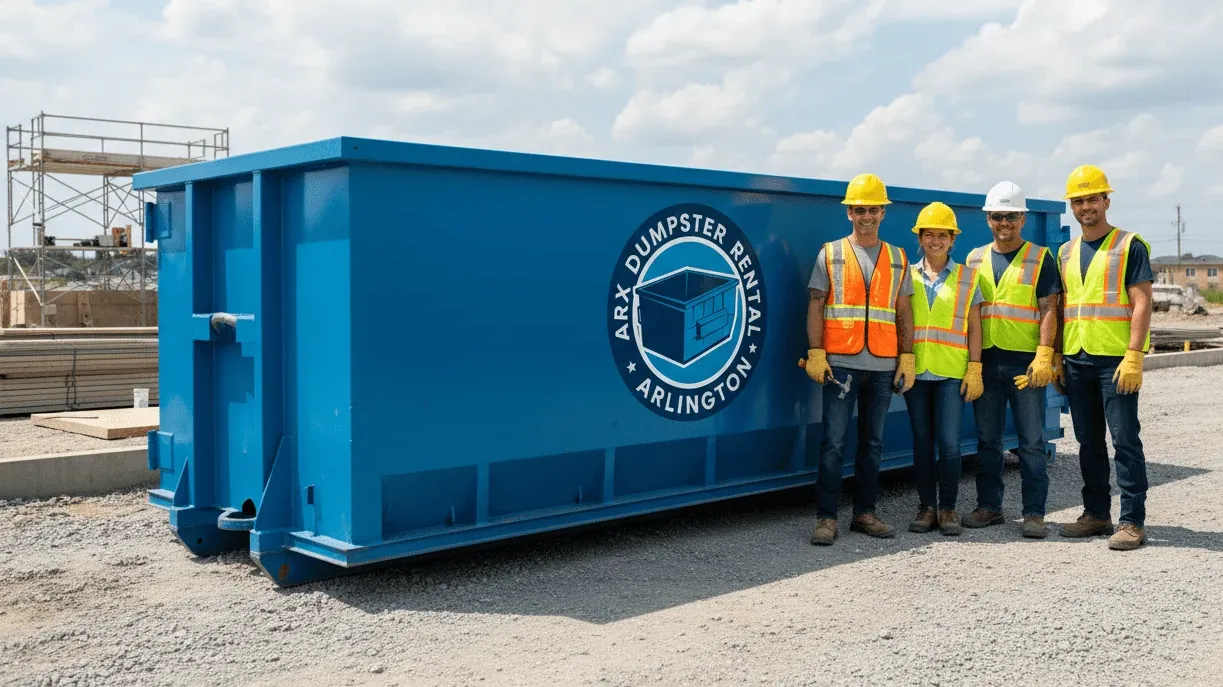
The City of Arlington states it in one sentence, and every contractor working Tarrant County should have it memorised: “Construction debris and roofing shingles cannot be collected curbside. Contractors bear responsibility for hauling away these materials.” There is no volume at which that changes and no permit that buys an exception.
Put the numbers beside it. Arlington allows a household roughly two cubic yards of bulky items a week and roughly two cubic yards of brush and yard waste a week. Generous for a garage clearout. Against a kitchen gut, a re-roof, a pier job or a teardown it is no answer at all, and that gap is why roll-off containers exist here.
Contractors are excluded from the homeowner concessions, twice over
The three free Arlington Landfill drop-offs are not available to you. Eligibility is narrow: an Arlington Water Utilities account holder who is a homeowner in Arlington, non-transferrable, ID checked at the scale house. Contractors, landlords and apartment tenants pay regular landfill fees and get no free visits. If a customer offers to let you run a load under their name, non-transferrable is exactly what that means.
The household hazardous waste route is closed as well. Arlington sends residents to the Fort Worth Environmental Collection Center, and the centre is explicit: residential waste only, commercial, business or industrial waste cannot be accepted. The leftover paint, solvent or thinner from an Arlington job is yours to route through a commercial handler. Price both exclusions into the bid rather than finding them in week three.
Separation is where the money is
The biggest lever on disposal cost is not box size, it is whether what goes in the box is one material or five. Clean loads have destinations mixed loads do not, and the difference lands on the scale ticket. Five streams are worth pulling on any job of size: clean concrete, which has a recovery route as crushed base; scrap metal, which is worth money rather than costing it; clean wood; cardboard, real volume on a production house; and vegetative debris, which goes to mulch. One broken pallet on ten tons of concrete makes it a mixed load with the density of concrete.
Most of it ends at the Arlington Landfill: 800 Mosier Valley Road, Euless, city-owned and Republic-operated, Monday to Saturday 7:00am–4:30pm, (817) 354-2305. It takes green waste for mulch, concrete, metal and electronic waste, and no household hazardous waste. It is one facility under two names, not two gates. And the geography is odd: it carries a Euless address and is not inside Arlington city limits, though TCEQ lists it as “City of Arlington Landfill, Tarrant County”. Call the scale house for current gate requirements.
| Debris type | Separation | Container |
|---|---|---|
| Flatwork, drives, slab breakout, footings | Clean concrete only, no wood or soil | 10 or 15 yard, flat |
| Wet clay spoil from pier holes | Own box, part filled, never topped off | 10 yard |
| Shingle tear-off and felt | Own load, a weight job not a volume job | 15 or 20 yard |
| Framing lumber, offcuts, pallets | Own box; one bag of trash ends it | 30 or 40 yard |
| Limb wood, brush, stumps, root balls | Clean vegetative, no soil, no trash | 15 or 20 yard |
The constraint is distance: a crew sorts into a box ten steps from the work, not one across the lot, so a phased job wants swap cycles rather than one box parked for the duration. Our construction dumpster rental and commercial dumpster rental pages cover that, and the size range runs 10 through 40 yard.
What cannot go in the container, with the Texas citations
Texas keeps a short, specific landfill ban list at 30 TAC §330.15(e), and two entries on it are missed constantly.
- Asbestos-containing material — never, in any amount, in any container.
- Lead-acid batteries — §330.15(e)(1).
- Used motor oil from do-it-yourself sources — §330.15(e)(2).
- Used oil filters — §330.15(e)(3). A separate ban from the oil itself, and the one most frequently missed.
- Whole used or scrap tires — §330.15(e)(4). Banned whole unless processed first, so not a blanket ban on tires.
- CFC appliances — §330.15(e)(5), conditional: refrigerant recovered by a certified technician under 40 CFR Part 82 first, then the shell is ordinary metal.
- Bulk or non-containerised liquid waste — §330.15(e)(6).
Now the part that saves arguments: yard waste, electronics, mattresses and paint are not banned in Texas, whatever guides written for other states say. On all four the constraint is cost and sorting, not law. Our page on what can go in a dumpster in Tarrant County works through the full list.
Asbestos and demolition: DSHS, not TCEQ
This is the most commonly botched fact about Texas. In most states the environmental agency runs asbestos notification. In Texas, EPA delegated it to the health agency: the Texas Department of State Health Services. TCEQ regulates the waste stream, but the notification goes to DSHS. Filing with the wrong agency is the same as not filing.
The clock is at least 10 working days before demolition or abatement begins — working days, not calendar days, so about two calendar weeks, longer across a holiday. And the item that ends the most schedules: notification is required before demolition of a building or facility even when no asbestos is present. A clean survey does not remove the duty, it changes what the notification says.
The rules are at 25 TAC Chapter 296, recodified from the former Chapter 295, so older documents still cite 295.xx. §296.1(c) exempts a single private residence or a single apartment building with no more than four dwelling units — note how narrow that is, because it covers one residence. A five-plex, a strip retail unit or a subdivision teardown programme is not exempt. Where non-friable asbestos-containing material exceeds 160 square feet, 260 linear feet or 35 cubic feet, a DSHS-licensed consultant is required. DSHS Asbestos Programme: 512-834-6747, rules published by Texas DSHS.
Buildings from before 1980 routinely carry asbestos in floor tile and black mastic, pipe wrap, textured ceilings and roofing felt, and pre-1978 buildings carry lead paint under the EPA RRP rule. Neither slows a job caught at bid; both stop one cold on demolition day. Once abatement is signed off, the rest is ordinary demolition debris.
Arlington's demolition permit and the 50-year trap
A demolition permit runs through the Commercial Building Permit system, and three attachments cause most of the delay: an aerial site plan showing the limits of demolition, proof of an asbestos survey, and a SWPPP for sites over one acre.
Then the trap. If the building is 50 years or older, if its age cannot be determined, or if it sits in the Landmark Preservation Overlay, the Landmark Preservation Commission reviews it. The LPC meets the second Thursday of the month, applications are due at least nine business days before, and while it cannot deny the permit it can extend the Historic Stay by 45 days.
The trigger is not exotic here, it is normal: Arlington's stock now trips the 50-year threshold for everything built through roughly 1976, which is most of central and north Arlington. The compounding critical path is why experienced builders start paperwork before they close on the parcel:
- LPC filing, nine business days before the meeting. Miss it by a day and you wait a month.
- The LPC meeting — second Thursday, once a month, no more often.
- A possible 45-day Historic Stay.
- DSHS notification, 10 working days, concurrent if the survey was done early, sequential if it was not.
- Demolition.
Worst case, that is a filing deadline, a monthly meeting, a 45-day stay and a two-week notification window in front of an excavator booked for next Tuesday. Best case, with the survey done at bid, most of it overlaps. Requirements are published by the City of Arlington.
Digging: Texas811, two working days
The moment a job goes into the ground — pier footings, a pool demo, a fence line, a driveway tear-out — notification applies, and Texas811 is the notification centre. Under Texas Utilities Code Chapter 251, notice goes in no earlier than the 14th day before excavation and no later than 48 hours before, excluding weekends and holidays — two working days. Penalties run $500 to $1,000 first violation, rising to $2,000 to $5,000.
None of it applies to setting a container on a driveway; all of it applies to the work that generates the container. That spoil is covered on our page about foundation repair and concrete debris in Arlington.
The container in the street
There is no dumpster-specific permit in Arlington's published code, which is not the same as a blanket “no permit needed”. Streets and Sidewalks §6.01 prohibits obstructing any public sidewalk, curb, shoulder, street or right-of-way in the city, so a container in a travel lane is an obstruction whether or not a dumpster ordinance exists.
A lane closure needs a Temporary Traffic Control Permit from Public Works: minimum three business days, a $500 per day non-compliance fine, and Texas MUTCD compliance. In state right-of-way — a TxDOT frontage road along I-20 or I-30 — TxDOT approval comes first. On a private driveway, no city street permit is identified as required. Our notes on dumpster permits in Arlington go through the desks.
Duration is the question we field most, and the answer surprises people: there is no ordinance limiting how many days a container may sit. The real exposure is the Nuisance chapter, §2.02(M), which makes “used, deteriorated or discarded building materials” a nuisance — but expressly exempts materials stored in a workmanlike manner in conjunction with an active building permit. Read that twice, because pulling the permit is itself the defence. An unpermitted job with debris drifting across a side yard is outside it.
Weight discipline on a Tarrant County site
Three materials reach payload long before the box looks full. Wet clay excavation spoil is the worst: Blackland clay holds water in a way sand never does, so a pier-hole pile filling a third of a 10-yard box will end a load. Never put spoil in a 30 or 40 yard box — the truck legally cannot haul it out.
Broken concrete catches crews on the last swap of the day, when there is room at the top and the temptation is to fill it. Shingle tear-off is the third: a composition tear-off is a weight job, not a volume job. Load flat, keep clean concrete separate, and if a box still has room at the rails on heavy material, that is the box telling you it is finished. Concrete and heavy debris containers are sized for it.
Swap-out logistics on a running job
On a phased job the container schedule follows the trades, not the calendar. Demolition produces in bursts, framing steadily, and finish work produces cardboard and offcuts in volume nobody forecasts. What works is a box staged where the current trade is working, swapped at the end of the heavy day rather than the following week. Give us the gate code and access notes before delivery: a roll-off truck wants roughly sixty feet of straight approach. And confirm the jurisdiction — an Arlington mailing address is not the same as being in Arlington, because Pantego and Dalworthington Gardens are separate incorporated towns.
Builder punch-out in Viridian and south Arlington
New-build punch-out has its own rhythm. In Viridian and the newer south Arlington subdivisions the debris is light and bulky rather than heavy: cardboard from cabinets and appliances, packaging, offcuts and pallets. The right answer is a larger box worked hard, not a small one filled with air, and the constraint is access rather than weight, with four trades parked on a street built for two. Viridian sits under its own Municipal Management District, so confirm placement rules before delivery.
ARX Dumpster Rental has hauled for Arlington builders, roofers and remodelers since 2012, out of the yard at 1200 N Commercial Blvd in south Arlington. Andre Reyes still answers the phone. Tell us the job type and the phase schedule and we will tell you what to stage and when — (817) 404-4864, or the contact page.
Questions this guide did not answer? Call (817) 404-4864. We would rather spend two minutes on the phone than have you order the wrong container.