
Roofing
Roofing Tear-Off Dumpster Size Guide for Arlington
A shingle tear-off is a weight job. Size it by squares and by how many layers are already up there, then plan around the hail claim cycle that drives nearly every re-roof in Arlington.
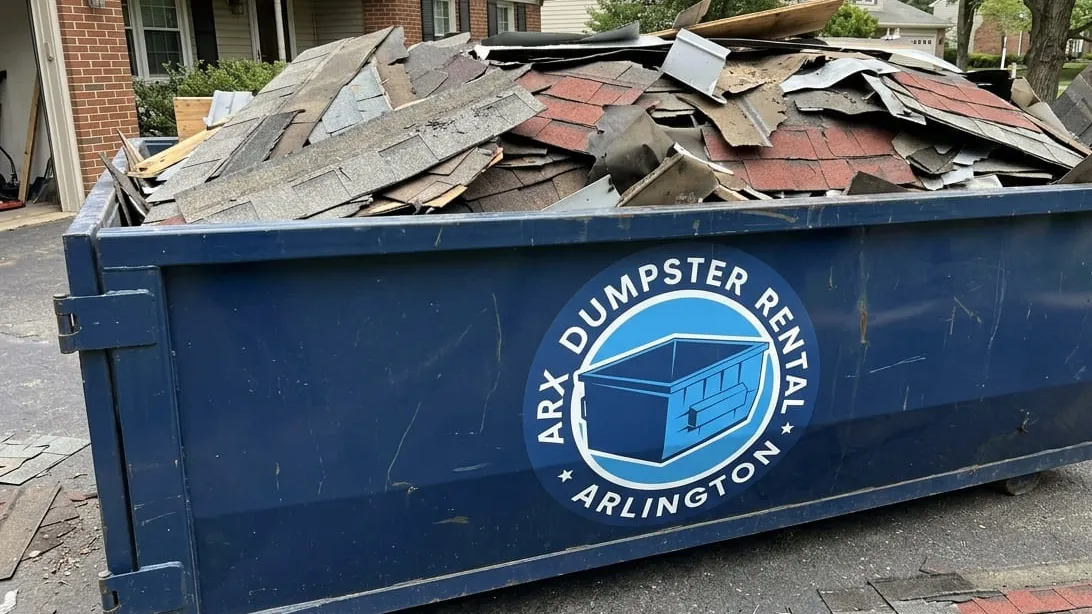
Roofing is the one job where the square footage of the house tells us almost nothing. What we need is the roof measured in squares and the number of layers already on it, because a tear-off is a weight job. Volume runs out slowly on shingle and weight runs out fast, and weight decides whether the truck can pick the box back up off your drive.
A square, and why layers matter more than floor area
A square is 100 square feet of roof surface. It is the unit every roofer, supplier and adjuster here works in, and it is not the floor area of the house. Pitch, hips, valleys, dormers and overhang all add surface, so a 2,000 square foot single-storey Arlington house is usually a 24 to 28 square roof, not a 20. Take the number from the roofer's proposal or the adjuster's report, not from appraisal district square footage.
Then the material. Arlington roofs are asphalt and composition shingle, and a single layer runs roughly 250 lb per square for three-tab, closer to 300 to 400 lb for heavy architectural laminates. Add 5 to 10 percent for felt, underlayment, drip edge, ridge, boots and nails, more again if the decking is coming off.
Now the part that changes the container. A second layer roughly doubles the tear-off weight and a third roughly triples it, on the same roof, with the same footprint. Nothing looks different from the kerb; the box just runs out of weight at half the volume.
Older central Arlington roofs are the ones most likely to be multi-layer. The city went from 7,692 people in 1950 to 160,123 by 1980, so the neighbourhoods around downtown, around UTA, and through Woodland West, Fielder and Rush Creek have had fifty to seventy years of roofing decisions made on them, and a layover was ordinary practice for much of that. Newer stock in far south Arlington and Viridian is almost always a single layer. If you are not sure, count the courses in the cut edge at a rake or eave, or ask the crew on the first morning — the container can still be changed then, and not once the box is full.
The sizing table
Weights are shingle plus underlayment and fasteners, rounded, assuming a standard laminate. Staged means one box in the drive with a swap booked in advance, not a bigger box — on a multi-layer tear-off, road weight runs out before the walls of the container do.
| Roof size | Layers | Approximate weight | Container that works | Notes |
|---|---|---|---|---|
| 15 squares | 1 | ~2 tons | 10 to 15 yard | Small ranch. Volume decides here, not weight. |
| 15 squares | 2 | ~4 tons | 15 yard | Common on a 1960s central Arlington house. |
| 20 squares | 1 | ~2.6 tons | 15 yard | One pull, room to spare. |
| 20 squares | 2 | ~5.2 tons | 20 yard | The row people underestimate. Same roof, twice the load. |
| 20 squares | 3 | ~7.8 tons | 20 yard, staged | Two pulls. Do not force it into one. |
| 30 squares | 2 | ~7.8 tons | 20 yard, staged | Book the swap before day one, not day two. |
| 30 squares | 3 | ~11.5 tons | Staged, two to three pulls | A scheduling job. Talk to us first. |
| Decking off | Any | Add plywood | One more pull | Bulky, not heavy. It eats the space shingle left. |
Dimensions are on the dumpster sizes page, with a general walk-through in what size dumpster you need in Arlington. The three doing nearly all the roofing work here are the 10 yard, 15 yard and 20 yard.
Arlington is asphalt and composition shingle country
We do not publish a market-share figure, because nobody publishes a defensible one. Two pieces of public evidence say plenty on their own. The city publishes shingle-specific disposal guidance, and a municipality writes rules about the material its residents generate. More telling, Texas Property Code §202.011 exists to stop an association blocking wind- and hail-resistant shingles. A legislature does not pass a shingle statute for a metal-roof market.
Hail, the season, and why booking early beats booking right
Most re-roofs here are the back half of an insurance claim, and they land all at once. In the National Weather Service Fort Worth area, April and May account for roughly 55 percent of all tornadoes — 555 in April and 525 in May since 1950, about seven each per year. What most guides miss is the genuine secondary peak in October, 145 on the same record. The core hail window runs March through June, then a smaller convective season arrives in autumn. If a roof was marginal in spring and you waited, October is not a safe month to be waiting in.
The state recorded 902 hail events in 2025, ahead of Kansas at 375 and Oklahoma at 369, and more than 235,000 Texas homes took damaging hail that year. Texas leads the nation for hail, and DFW sits in the highest-risk tier. That is the accurate framing, and it is enough.
After a hail line crosses the metroplex, every roofer, adjuster and container in Tarrant County is spoken for inside a week. Not a month — a week. Crews arrive from out of state, supply houses go on allocation, and the fleet is committed to jobs booked the morning after the storm.
So book early rather than book right. A container size can be changed with one phone call the day before delivery; a slot on the truck in the second week of May cannot. If the adjuster has been out and you have a scope, get a date on the calendar even while you are still choosing shingle colour. The rest of the storm sequence is covered in hail and storm damage cleanup in Arlington, and the National Weather Service publishes the seasonal outlooks worth watching.
The kerb will not take shingles, at any volume
This is the most important disposal fact for an Arlington re-roof, and the city states it plainly.
"Construction debris and roofing shingles cannot be collected curbside. Contractors bear responsibility for hauling away these materials, though residents may dispose of shingles directly at the landfill."
There is no volume at which this changes. The weekly bulky allowance of about two cubic yards is a washer and a dryer, not a roof, and a 25 square tear-off is several tons the collection contract will not touch. Current guidance is on the City of Arlington site, with more in our guide to dumpster rules and permits in Arlington.
Shingles go to the Arlington Landfill, 800 Mosier Valley Road, Euless — city-owned, operated by Republic under long-term lease, and one facility despite turning up online under two names. Hours are Monday to Saturday, 7:00am to 4:30pm, closed Sunday. Two things before planning a self-haul:
- The three free drop-offs a year are for Arlington homeowners on a Water Utilities account, with photo identification at the scale house. Contractors get no free visits. A roofer hauling your shingles pays regular rates every trip, and that cost is in your bid whether it is itemised or not.
- A pickup bed holds a fraction of a square before it is over its axle rating, so a whole roof self-hauled is a fortnight of trips.
§202.011, and what an HOA can and cannot stop
If you are upgrading to an impact-resistant shingle and the association pushes back, read the statute rather than the newsletter. Texas Property Code §202.011 says an association may not prohibit a shingle designed primarily to be wind and hail resistant, provided it resembles what is authorised in the subdivision, is more durable and of equal or superior quality, and matches the aesthetics of surrounding property.
Those conditions are conjunctive, which people get wrong in both directions. The shingle must be functionally superior and aesthetically consistent. An association cannot block an impact-rated upgrade on aesthetic grounds when the product looks right on that street, but it can object when it does not — a better shingle in a profile or colour nothing else in the subdivision carries is not protected here. The sensible order is to take the manufacturer's data sheet and a colour sample to the architectural committee and get approval in writing before the tear-off is booked. The statute text is on the Texas statutes site.
Asbestos on a pre-1980 roof
Roofing felt, mastic and built-up systems installed before 1980 can contain asbestos. On a plain shingle tear-off it is uncommon, but it is a live question on an older low-slope section, a flat porch or garage roof, or a patched-over built-up system on a 1950s or 1960s house near downtown. We cannot take asbestos-containing material in any container, on any job. Test rather than tear off; a positive result goes to a licensed abatement contractor.
The Texas detail that catches out-of-state contractors: notification goes to the Department of State Health Services, not TCEQ. It is due at least 10 working days ahead — working days, so about two calendar weeks, longer across a holiday — and it is required before demolition of a building even when no asbestos is present. A clean survey does not remove the duty; it changes what the form says.
The exemption covering most roofing customers is §296.1(c), which excludes a single private residence or a single apartment building of no more than four units. A homeowner re-roofing their own Arlington house is outside the notification regime. A five-plex or a strip retail unit is not. Programme information comes from DSHS.
Placement, and what a tear-off does to a driveway
A re-roof is a crew shovelling from height. Debris comes off the eave in a steady stream and lands where gravity puts it, so set the box where the pitch drops, not where it looks tidiest. Every ten feet the crew carries shingle by hand is thousands of pounds moved further than it needed to go.
- Protection boards go under the rails on every set, without exception. A loaded roofing box is a concentrated load on ground that already moves seasonally here.
- Approach: roughly 60 feet of straight run to set a box down and hook it back up, and about 10.5 feet of width past gates, fences and parked vehicles.
- Overhead: 20 feet or more of clear vertical space. The reliable obstruction here is a mature post oak, live oak, cedar elm or pecan over the drive — the 1970s and 1980s neighbourhoods are full of them, and the tree stops a hoist arm on a driveway that would otherwise be fine. Look straight up before you book.
- Tarps and magnets: tarp the beds between eave and box, and sweep the drive and lawn with a magnet when the last bundle is up.
- The street is a different question. If a lane or traffic flow is affected, Public Works handles a Temporary Traffic Control Permit and asks for three business days minimum. On a private driveway, no container permit is identified in the city code.
Heat decides how many days the box is in the drive
DFW normals put the July average high at 95.6°F and August at 95.8°F, with 20.2 days a year at or above 100°F. The average first 100° day is about 1 July, the average last about 27 August — roughly eight weeks where the deck is unworkable by late morning.
Crews start early and are off the deck by mid-morning through that window. Hot shingle tears differently, scuffs underfoot and is dangerous to walk on in the afternoon. A tear-off that runs a day and a half in April runs three or four short mornings in late July. So keep the box longer than the working hours suggest, and book swaps for first thing, so the full container leaves while the crew is still on the roof.
Which box, and what to tell us
For a single-layer roof under about 25 squares, the 15 yard is usually right. For two layers, or anything over 25 squares, the 20 yard is the working box. Three layers on a large roof is a staged job and we will say so on the phone. The 10 yard is not a compromise — it is right for garages, additions and single-slope repairs, and it fits a narrow drive.
Keep the load clean. Shingle, felt, flashing, boots, ridge vent and nails ride together. Do not mix in broken concrete or limb wood off the same storm — concrete belongs on a heavy debris load and limb wood runs cleaner as its own pull.
Four things and we can size it on the phone: the square count, the number of layers, whether the decking is coming off, and whether a date is fixed by an adjuster deadline. The rest is on our roofing dumpster rental page.
ARX Dumpster Rental has run roll-offs from the yard at 1200 N Commercial Blvd in south Arlington since 2012. Andre Reyes started with one truck and four cans and still answers the phone, early in hail season. Call (817) 404-4864 or use our contact page, and tell him the squares and layers before he asks.
Questions this guide did not answer? Call (817) 404-4864. We would rather spend two minutes on the phone than have you order the wrong container.