
Delivery
Driveway Protection on an Arlington Dumpster Delivery
Arlington driveways sit on clay that opens four-inch cracks every summer. How we set a loaded roll-off on concrete, pavers, asphalt and gravel without leaving a mark.
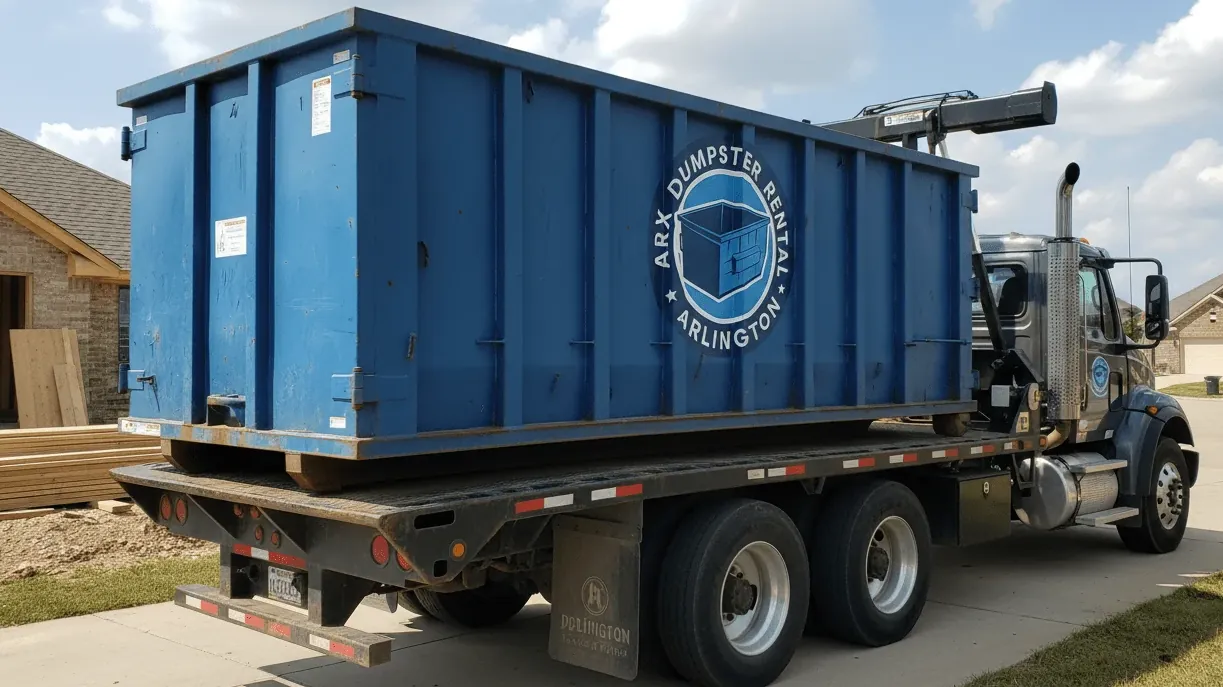
Nobody rents a container because they were thinking about their driveway. Then the truck backs in, several tons of steel roll down the rails onto the slab, and the drive becomes the only thing the customer is thinking about. We have set roll-offs out of the yard in south Arlington since 2012, and this is the part of the job we take slowest. Everywhere else the question is whether the concrete can carry the load; here there is one underneath it, which is whether the ground carrying the concrete has been holding still.
Your driveway is sitting on ground that moves
The reference for the soil under much of this city is the USDA soil survey, not a brochure. Houston Black, the Texas state soil, is a Vertisol, and the USDA Natural Resources Conservation Service series description puts figures on it: 40 to 60 percent clay, shrink-swell rated high, cracks 0.5 to 4 inches wide running 12 inches or more deep, open 90 to 150 cumulative days a year. Four-inch cracks a foot deep, open three to five months out of twelve. That is what your slab bears on.
The National Weather Service describes DFW rainfall as bimodal — wet spring, dry summer, wet autumn, dry winter — and the region averages 20.2 days a year at or above 100°F. Through July and August the clay dries, shrinks and pulls away from the slab perimeter and the edges of the drive; autumn rain returns and it heaves. That annual breathing, not any one storm, moves flatwork here.
Which brings up the sentence that matters most here. A great many Arlington driveways already have hairline cracks and a settled or lifted panel before any truck of ours turns into the street. That is what this soil does over decades, not a criticism of the concrete work. It is also exactly why our driver photographs the approach and the set spot on arrival, before anything touches the ground, which protects the customer at least as much as it protects us.
And it is not the same soil across town
Calling Arlington uniformly Blackland clay is a half-truth. Tarrant County exposes its geology in north–south bands, so where you stand decides what is under you:
- Eagle Ford Group — shale weathering into the classic expansive clay. The problem unit.
- Woodbine Formation — sandstone with clay and shale. Sandier, more variable.
- Austin Chalk — steadier limestone along the eastern escarpment toward Grand Prairie.
- Trinity River and Village Creek alluvium — clay, sand and gravel north and centre.
Conditions change over a few miles, which is why flatwork and foundation performance genuinely varies street to street.
What is actually pressing on the concrete
A roll-off does not rest on its floor. It sits on two steel rails running the length of the box plus a pair of wheels at the back, so the whole weight arrives through a handful of small contact patches. That is point loading, unlike a car, which spreads its weight over four soft tyres and keeps moving. An empty box is already several tons; fill a 20 yard with tear-off, broken concrete or wet clay spoil from a foundation repair job and you are into five, eight, ten tons or beyond, all of it on those rails and wheels for a fortnight.
And the truck is heavier than the box. A loaded roll-off truck is the heaviest thing that will ever drive on a residential driveway, and it comes up the apron, over the joints and back down again, so its wheel path matters as much as the footprint of the can. The apron where the drive meets the street is the usual casualty.
The answer to point loading is not complicated and it is not optional here. Protection boards go down under the rails and under the wheels on every residential set. They spread the load, so instead of a few concentrated points the weight goes into the drive across a broad area — the difference between a slab that takes a loaded box without complaint and one that cracks at the nearest joint. On the surfaces that worry us the boards get doubled.
Arlington driveways, surface by surface
Original 1950s and 1960s concrete
Arlington went from 7,692 people in 1950 to 44,775 in 1960, and drives poured that decade around downtown and the university are still in service: thin, often one car wide, frequently unreinforced, six decades on moving clay. These take a smaller box or a mid-job swap; our size guide has the footprints.
The 1970s and 1980s cohort
The largest cohort in the city — Woodland West, Fielder, Rush Creek, the Bowen corridor. Thicker concrete, better reinforced, two cars wide, and it will usually carry a loaded box on boards without drama. Watch the control joints, which are deliberate weak lines the slab is meant to crack along: the driver sets between them and keeps the rails off any panel already out of plane.
Newer stamped and coloured concrete
Structurally the strongest flatwork on the list, and here the risk is cosmetic. The colour is often surface-applied over a profiled pattern, so steel bearing on it marks a finish that will not clean off and cannot be patched invisibly. Say it is stamped when you book.
Pavers and interlocking brick — the highest-risk surface
Plainly: a paver driveway is the surface most likely to need repair after a container has sat on it, and we will often recommend setting somewhere else. Pavers are individual units on a sand bedding layer over compacted base. A rolling tyre spreads its load and never dwells; a steel rail is a static line load in one place for days. The sand migrates out from under it, the field loses interlock, units dish and roll at the edges, and the repair means lifting, re-screeding and resetting the run. We set on pavers with doubled boards, but on a heavy job we would rather use the kerb or a side yard.
Asphalt
Less common here than concrete, with one specific weakness. On a July or August afternoon — average highs of 95.6°F and 95.8°F, with a black surface in sun running well above the air temperature — the bitumen binder softens. The rails do not crack asphalt or tear it; they sink slowly through the afternoon, and the surface keeps the shape once it cools overnight. Say it is asphalt on the phone and take the first slot of the day.
Gravel and dirt approaches
Toward the rural edges — the southwestern side toward Kennedale and Crowley, the run down to Burleson — the drive is often gravel or dirt over clay. Dry, it carries the truck. Wet, it ruts, and clay ruts are not raked out in an afternoon. We set on the firmest section we can reach, and if it is soaked we offer another day.
| Surface | Main risk here | What we do |
|---|---|---|
| 1950s–60s concrete | Thin, unreinforced, old | Doubled boards, smaller box |
| 1970s–80s concrete | Cracking at a control joint | Boards down, set between joints |
| Pavers and brick | Dishing, edge roll, sand migration | Doubled boards, or a different spot |
| Asphalt in summer | Binder softens; the print stays | Doubled boards, first slot |
| Gravel or dirt | Rutting when wet | Firmest run, or reschedule |
What the truck needs, and what to do the day before
Working numbers across every size we run: about 60 feet of straight approach for truck and container, about 10.5 feet of width for the truck and its mirrors, and 20 feet or more of overhead clearance while the hoist works — the figure people get wrong, because they measure the box rather than how high the arm reaches as it tips.
- Move the cars the night before. A blocked drive is a return trip.
- Mark the exact spot with a cone, a scrap of two-by-four or a chalk line, then text us a photograph of it.
- Clear the approach — bins, planters, the trailer at the kerb opposite.
- Say what the surface is — pavers, stamped, asphalt, old thin pour, gravel.
- Say what is soft or buried — a recent trench, an irrigation line, the damp corner.
Look up: the Arlington overhead list
In some cities the first overhead obstruction is a power drop. Here it is almost always a tree. The 1970s and 1980s neighbourhoods carry fifty years of canopy over the drive, and the species that give us trouble are post oak, live oak, red oak, cedar elm, pecan and hackberry. A limb at twelve or fourteen feet is nothing to a car and a hard stop for a hoist arm at twenty. After the trees come the service drop, basketball goals over the apron, and carport framing — no box goes under a carport. Trimming beforehand settles it, and the limb wood is its own roll-off conversation.
Rain, freeze and the delivery calendar
Spring and autumn are the wet halves of the DFW year, and that is when placement judgement matters most. After heavy rain a clay yard is not merely muddy: it has taken water into a soil that expands, and it will rut deeply under a loaded truck and hold that shape as it dries. If we are crossing grass or a soft shoulder the day after a hard rain, we would rather move you a day than leave marks.
Winter here is an ice and hard-freeze problem rather than a snow problem: DFW averages 29.2 nights a year at or below freezing. A container sitting through a hard freeze is a different proposition from one that sits a week in May. Water gets into the joints and existing cracks, freezes and works on flatwork already stressed by the summer's shrinkage. During an ice event we hold deliveries until surfaces are safe and tell you rather than leaving you watching the window. The National Weather Service is worth a look before you plan around a front.
HOA rules, and what Arlington's code actually says
If your neighbourhood has an association, the association is the first authority on placement and duration, not the city. Placement and duration sit in your CC&Rs and architectural guidelines. Be clear about the legal position, because national sites get it wrong: there is no Texas statute protecting a homeowner's right to place a container. Chapter 202 of the Property Code lists what an association may not prohibit — solar devices, flags, religious displays, rain barrels, hail-resistant shingles under §202.011. Containers are not on it.
On the city side, two things are commonly misreported. Arlington has no ordinance limiting how many days a container may sit, and no screening requirement. What does exist is the Nuisance chapter, §2.02(M), which treats discarded building materials as a nuisance — with an express exemption for materials stored in a workmanlike manner in conjunction with an active building permit. So the real exposure on a long-sitting container is nuisance enforcement rather than a dumpster clock, and pulling the permit is itself the defence. More in our guide to dumpster permits in Arlington.
When the driveway will not take it
Sometimes the drive is the wrong place: a paver field under a demolition load, a sixty-year-old single-car pour, a soaked gravel approach. A gated side yard will often take a 10 or a 15 on a short, light rental, and it is a fair trade against a paver repair. Or we set at the top of the drive on the thickest section and you carry a little further, usually the right answer on a tight central Arlington drive. Our guide on what size dumpster you need works the sizing through, and same-day delivery makes a tight window workable.
If it does have to go in the street, Arlington's code has no dumpster-specific permit and we will not invent one. What applies is the general obstruction rule in Streets and Sidewalks §6.01, which prohibits willfully obstructing a sidewalk, kerb, street, roadway or public right-of-way. If a placement affects a traffic lane, that is a Temporary Traffic Control Permit from Public Works — allow a minimum of three business days, comply with the Texas MUTCD, and note the city's $500 per day fine for non-compliance. Confirm what your address needs with the City of Arlington; the requirements are theirs to state, not ours.
If it does go wrong
Steel, weight and old concrete occasionally meet badly, and how that is handled gets decided beforehand rather than after. The driver photographs the approach and the set spot on arrival, before the boards come off, and again at pickup once the box is gone. Take your own set as well. If something has changed between the two, we want to hear it that day, and then we have an honest conversation about what caused it. A hairline crack visible in the arrival photograph is a pre-existing crack, and we will show you. Damage we caused is damage we caused, and we deal with it rather than debating it.
Tell us about your driveway before the truck rolls
ARX Dumpster Rental has run containers out of 1200 N Commercial Blvd, off the I-20 corridor between Matlock and Collins, since 2012. Andre Reyes started with one truck and four cans and still answers the phone, which is why the detail is worth the call: describe the surface, the width and what hangs over the drive, and we bring the right size to the right spot with the boards loaded. Boards go down on every residential set, and if the surface will not take the box we say so standing there rather than afterwards. Call (817) 404-4864 or get in touch.
Questions this guide did not answer? Call (817) 404-4864. We would rather spend two minutes on the phone than have you order the wrong container.