
Disposal Rules
What Can Go in a Dumpster in Tarrant County: The Accepted and Prohibited List
The accepted and prohibited materials list for Arlington and Tarrant County: what 30 TAC 330.15(e) actually bans, the four things Texas does not ban that national guides claim it does, asbestos notification to DSHS rather than TCEQ, and where household chemicals really go.
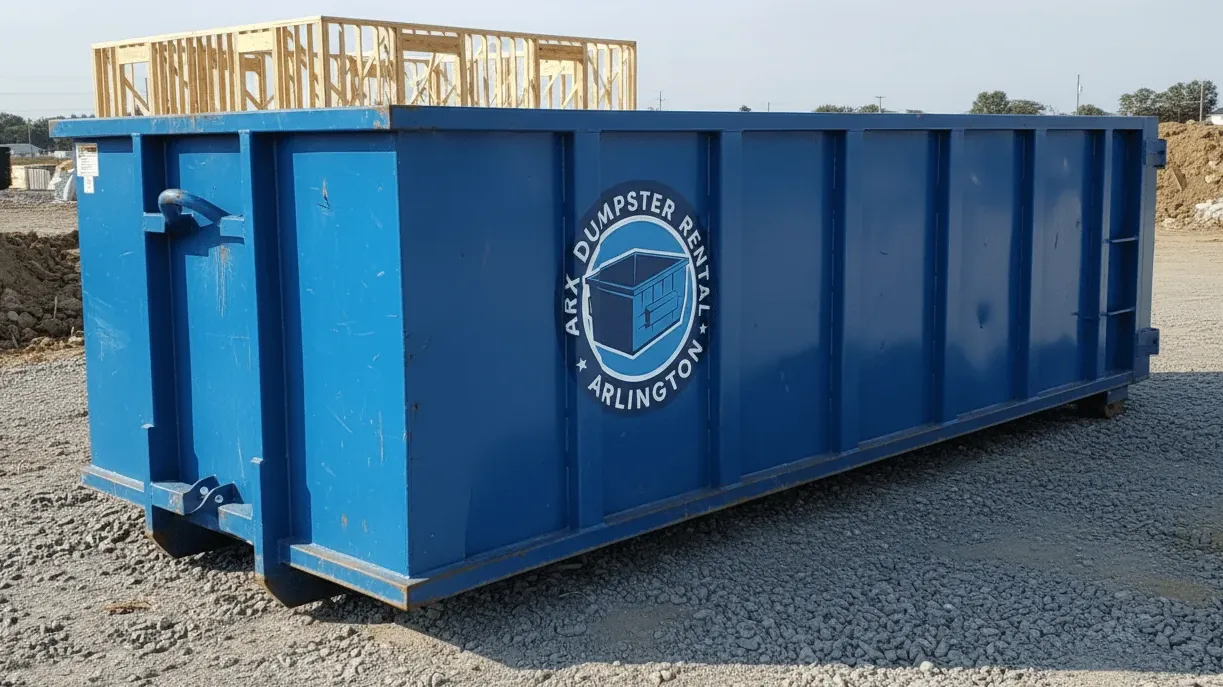
Andre gets this call most weeks, usually the morning before a delivery, and almost everything written online about it was written for somewhere other than Texas. Guides drafted for Florida, South Carolina or the northeast tell an Arlington homeowner that state law keeps yard waste out of the landfill, that the paint counter takes back leftover paint, that the state runs an electronics recycling programme, and that a mattress carries a recycling fee. All four are wrong here. This is the working list, in three parts.
List one: what goes in without a second thought
Most of what leaves an Arlington driveway is ordinary and acceptable. Construction debris is the backbone, roofing tear-off is its own load, and household junk out of a garage is fine.
| Material | In a container? | Notes |
|---|---|---|
| Lumber, plywood, OSB, trim, doors, windows, drywall | Yes | Standard C&D |
| Composition shingle tear-off, felt, flashing, decking | Yes — weight job | The kerb will not take it at any volume |
| Carpet, tile, laminate, cabinets, countertop | Yes | — |
| Broken concrete, slab, pier spoil, brick, block | Yes — clean load | Separated it recovers; mixed it does not |
| Limb wood, brush, stumps, bagged leaves | Yes — no Texas ban | Unbagged green waste is free at the landfill |
| Scrap metal, water heaters, ductwork | Yes | Pull it first — it has scrap value |
| Furniture, junk, fence panels, range, washer, dryer | Yes | 2 cu yd a week rides on the kerb free |
List two: what never goes in, and what Texas law actually says
National pages go wrong here because they list what their own state bans and assume Texas matches. The Texas prohibitions live in 30 TAC §330.15(e), the rule governing what a municipal solid waste site may not accept. It is short, specific, and not the list you have seen elsewhere.
| Material | Rule | Where it goes instead |
|---|---|---|
| Lead-acid batteries — car, mower, RV | §330.15(e)(1) | Core exchange or collection centre |
| Used motor oil from DIY changes | §330.15(e)(2) | Collection centre, 10 gallon limit |
| Used oil filters | §330.15(e)(3) | A separate ban most guides omit |
| Bulk or non-containerised liquid waste | §330.15(e)(6) | Solidify, or licensed disposal |
| Wet paint, solvent, fuel, pesticide, pool chemicals | Household hazardous | Fort Worth collection centre |
| Propane cylinders and any pressurised tank | Refused | Call before assuming a route |
Regulated hazardous waste, PCBs and radioactive material are prohibited separately, and asbestos has its own section below. Used oil filters deserve the emphasis: they sit at §330.15(e)(3) with their own paragraph number, banned in their own right rather than as a container of banned oil, and they are the entry most guides omit. The rule text is on the TCEQ site.
List three: it depends — six things people get wrong
Four of these are legal in a Texas landfill and widely reported as banned. Two are conditional, and the condition is not what people assume.
| Material | Banned in Texas? | What is actually true |
|---|---|---|
| Yard waste, brush, leaves, grass | No | No statewide ban. Arlington sends bagged leaves to the landfill |
| Electronics, TVs, monitors, computers | No | Manufacturer take-back only. The Arlington Landfill accepts e-waste |
| Mattresses and box springs | No | No Texas programme, no fee, no ban |
| Paint | No | Latex dries out and bins. Oil-based goes to hazardous waste |
| Whole used or scrap tires | Conditional | §330.15(e)(4) bans whole tires unless processed first |
| CFC appliances — fridge, freezer, window unit | Conditional | §330.15(e)(5) — refrigerant out first, then the shell is ordinary debris |
Yard waste is not banned in Texas
There is no Texas statewide landfill ban on yard waste or green waste. Not grass, not leaves, not brush, not the cedar elm limb that came down in an April line. Three lines of evidence: §330.15(e) does not list it; Texas is absent from the national roster of ban states; and the City of Arlington itself states that bagged leaves picked up at the kerb are not recyclable and go straight to the landfill. No city publishes that if a state ban exists.
Texas does encourage diversion without mandating it. The Arlington Landfill turns green waste into mulch, and residents and contractors may take unbagged leaves and limb wood there at no cost. We still run vegetative material as a clean separate load by choice and for cost, not because a statute says so — that is what a yard waste and brush container is for.
Electronics: take-back, not a ban
Texas has no landfill ban on electronics. What it has is manufacturer take-back: Texas Recycles Computers, created by HB 2714 in 2007, and Texas Recycles TVs. Both put the obligation on the manufacturer, not the disposal site. One boundary matters: the computer programme covers personal and home-business equipment only, so a commercial office, a government department or a non-profit sits outside it. The Arlington Landfill accepts e-waste.
Mattresses and tires
The Mattress Recycling Council operates in California, Connecticut, Oregon and Rhode Island only. No Texas equivalent, no recycling fee, no ban. A mattress is ordinary municipal solid waste here. Tell us when you book, because mattresses take volume out of all proportion to their weight and can decide the container size on a turnover — the size guide works from real loads.
Tires get mangled constantly. §330.15(e)(4) bans whole used or scrap tires unless processed first. It prohibits whole tires, not tires as a material, and the Arlington Landfill explicitly accepts tires from residents. For a rental it means only that we do not want them in a mixed container.
CFC appliances are conditional, not prohibited
A refrigerator, freezer, window unit or condenser falls under §330.15(e)(5): refrigerant must be recovered by a certified technician under 40 CFR Part 82 first. Once the unit is evacuated and tagged, the shell is ordinary disposable debris. A step, not a ban.
Asbestos: the one absolute, and Texas sends the notice to DSHS
There is no version of this where we take it. Not bagged, not at any price. Asbestos-containing material cannot go in any container of ours, ever. It goes to a licensed abatement contractor with its own disposal chain, and mixing it into a construction debris load contaminates the box.
Now the part almost every guide gets wrong. In most states the environmental agency administers asbestos notification, so writers assume TCEQ. In Texas it sits with the Department of State Health Services — DSHS, not TCEQ. TCEQ regulates the waste stream and the landfill that receives the material, but the demolition and renovation notification goes to DSHS. File with the wrong agency and you lose a fortnight.
- At least 10 working days before the start of demolition or abatement. Working days, not calendar days — about two calendar weeks, longer across a holiday.
- Required before demolition even when no asbestos is present. A clean survey does not remove the duty. It only changes what the notification says.
- The rules sit at 25 TAC Chapter 296, recodified from the former Chapter 295 — older handouts cite 295.xx, so expect both numbers.
- §296.1(c) exempts a single private residence, or a single apartment building with no more than four dwelling units. A homeowner gutting their own 1965 ranch off Fielder Road is outside the regime. A five-plex is not. Nor is a commercial unit.
Pre-1980 buildings routinely carry asbestos in floor tile and the black mastic under it, pipe and duct wrap, textured ceilings, and roofing felt and mastic — which covers a large share of central and north Arlington. Pre-1978 houses also carry lead paint, putting renovation under the EPA RRP rule. Confirm with DSHS before you set a date.
Paint and household chemicals: PaintCare does not operate in Texas
PaintCare does not run a programme in Texas. There is no take-back at the paint counter here, whatever a national page says. Latex and water-based paint may be dried out and put in the regular trash — lid off, kitty litter stirred in, left in the sun through a July afternoon. Once solid it is no longer a liquid, and dried cans can ride in the container. Oil-based paint, thinner and solvent must go to household hazardous waste.
Arlington has no permanent household hazardous waste facility of its own. Residents use the Fort Worth Environmental Collection Center at 6400 Bridge Street, open Thursday and Friday 11am to 7pm and Saturday 9am to 3pm, on 817-392-1234. For Arlington residents it is free, no voucher, once a month per household, with a driver's licence or water bill as proof. It takes automotive fluids, cleaning and pool chemicals, cooking oil, light bulbs, paint and paint supplies, pesticides and chemical batteries. Call ahead on anything pressurised, propane included.
One hard limit catches contractors: the centre is for residential waste only. Commercial, business and industrial waste cannot be accepted, so a painter finishing an Arlington job with five gallons of leftover solvent has no free route there. Details are on the City of Fort Worth site, and our recycling and disposal guide maps the rest.
The kerbside boundary: where the city stops and a container starts
Some of what people plan to load does not need to be in a box at all. Arlington runs one collection day for trash, recycling, yard waste and bulky items.
- Brush and yard waste: limbs cut to 4-foot lengths, large end toward the kerb, diameter no more than 6 inches, bundles limited to 50 pounds, roughly 2 cubic yards per household per week for brush, yard waste and bagged leaves combined.
- Bulky items: up to 2 cubic yards a week, which the city describes as washer or dryer scale.
- The line that decides most of our calls: the city states plainly that construction debris and roofing shingles cannot be collected curbside, and that contractors bear responsibility for hauling them away. Residents may take shingles to the landfill themselves.
Two cubic yards is a useful allowance for household turnover and useless for a project. A re-roof or a kitchen tear-out produces many times that in a day. Beyond construction debris, shingles and household hazardous waste we will not guess at what else the city refuses — ring the Arlington Action Center on 817-459-6777. If the container goes anywhere but your own driveway, the street side has its own rules, covered in the permit guide.
Legal is not the same as loadable
All of the following is acceptable and perfectly capable of putting a container over payload before it looks half full. Here the scale ticket is the constraint far more often than the walls of the box are.
- Wet clay excavation spoil from pier holes and perimeter tunnelling — heavy for its volume, and the most misjudged load we quote.
- Broken concrete — slab breakouts, pier access holes, driveway and patio tear-out.
- Shingle tear-off — a layer or two across an average roof is a weight job, not a volume job.
The rule when in doubt is a smaller box, and a clean load rather than a mixed one, because clean masonry has a recovery route that mixed debris does not. That is why heavy debris containers are their own service.
When something prohibited turns up
Best case, the driver spots it at pickup and leaves it beside the box. Worse case it reaches the scale house and comes back as a handling charge or a rejected load, and with regulated material it becomes an enforcement matter, the paperwork following whoever produced the waste. The habit that prevents nearly all of it takes ten minutes: before the container arrives, walk the pile once and pull four categories — anything holding a liquid, anything with a battery in it, anything with a compressor or refrigerant, and anything with a tire on it. That is most of the prohibited list in one wheelbarrow, ready for a run to Bridge Street. Where the sorting is itself the work, that is what junk removal is for.
ARX Dumpster Rental has run out of the yard at 1200 N Commercial Blvd in south Arlington since 2012. Andre Reyes still answers the phone, and if you cannot tell which side of a line something falls on, ask before you load it — (817) 404-4864, or the contact page.
Questions this guide did not answer? Call (817) 404-4864. We would rather spend two minutes on the phone than have you order the wrong container.