
Permits
Dumpster Permits in Arlington, TX: What Actually Applies
Arlington has no dumpster-specific permit anywhere in its published code, and no day limit either. What actually applies is the obstruction prohibition, a traffic control permit if the street is involved, the nuisance ordinance with its active-building-permit exemption, and the fifty-year demolition review.
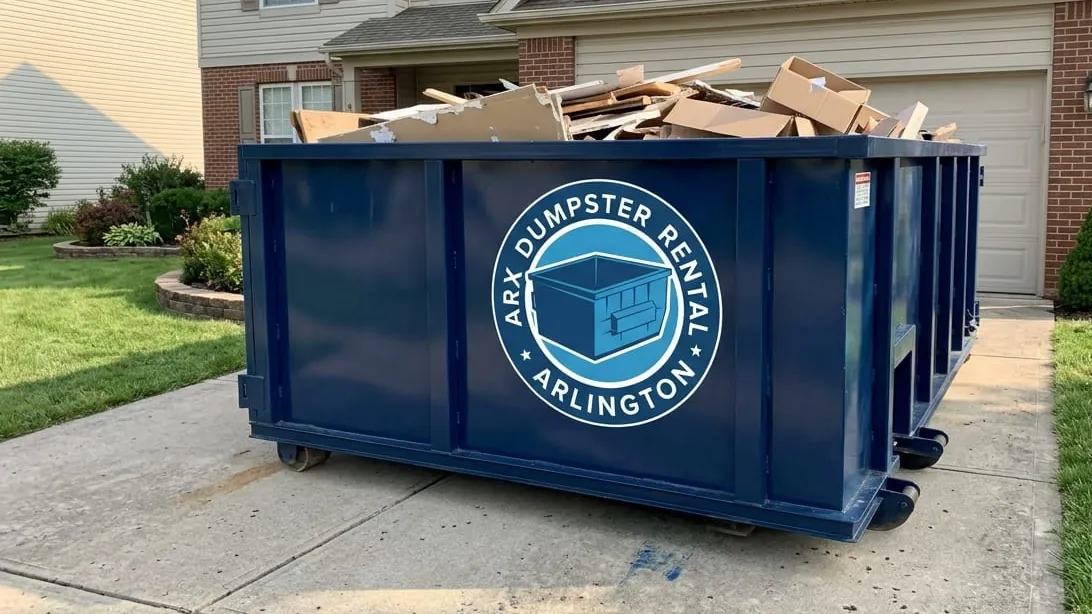
Right after size, the permit question is the one that comes in most. Arlington's answer is unusual enough to be worth stating precisely, because most of what circulates online was written for cities that handle this differently. We have been setting roll-offs across Arlington and Tarrant County since 2012, and the jobs that stall here are rarely held up by the thing the customer rang about.
There is no dumpster-specific permit in the City of Arlington's published code. Four chapters of the code and two permitting manuals were read looking for one, and not one names a dumpster, a roll-off container or a debris box. That is not the same as saying no permit is ever needed — the code does not support that claim either. It means the container is not the regulated object here. The regulated things are the ground it sits on, the traffic it affects, and the work it serves.
On a private driveway, no permit was identified
Most of what we set never touches a permit desk. A garage cleanout off Fielder Road, a re-roof in Rush Creek — if the box sits entirely on private property you own or control, what you need is the owner's permission, not a form from the city. That covers most of our residential dumpster rental work. The city's own guide supports this by omission: Arlington's "Do I Need A Permit?" page walks residents through roofing, solar and fences and never mentions containers.
Two conditions still hold, and neither is a permit. The sidewalk stays clear, and the container stays off the kerb line, because the moment part of it is in the right-of-way you are in a different section of the code. Our notes on driveway protection at delivery cover the surface side.
In the street, three things apply
Once any part of the container sits in the street, kerb lane, shoulder or right-of-way, three items come into play. None is called a dumpster permit, which is why people search for the wrong thing.
1. The general obstruction prohibition
Arlington's Streets and Sidewalks chapter, at §6.01, states that "no person shall willfully obstruct or injure … any public sidewalk, median, curb, shoulder, improved shoulder, street, highway, roadway or public right-of-way in the City." It does not name containers and does not have to. It covers anything placed in a public way that obstructs it, and it is the baseline under every street placement here.
2. Temporary Traffic Control Permit
If the placement affects a travel lane or the flow of traffic, that is a Temporary Traffic Control Permit question, and it runs through Public Works at publicworks@arlingtontx.gov.
- Allow a minimum of three business days for review, starting from a complete application rather than your first email.
- Traffic control must comply with the Texas MUTCD. Cones from the garage do not satisfy it.
- The city publishes a $500 per day fine for non-compliance. Per day, which on a week-long placement dwarfs the rest of the job.
One more layer catches people on the highway corridors. Work in state right-of-way — a TxDOT frontage road along I-20 or I-30 — needs TxDOT approval before the city will approve it. Two agencies in sequence, not in parallel.
3. Public Right-of-Way Permit
Construction work in the right-of-way runs separately through a Public Right-of-Way Permit, administered by Economic Development Services, Right-of-Way Division on (817) 459-6634 or rowpermits@arlingtontx.gov. If the project involves cutting, trenching or building in the ROW rather than setting something in it for a few days, that is the desk.
Who holds what
| Situation | Who holds it | Contact or note |
|---|---|---|
| Placement affecting a lane or traffic flow | Public Works, Temporary Traffic Control | publicworks@arlingtontx.gov · three business days · Texas MUTCD · $500/day |
| Construction in the right-of-way | Economic Development Services, ROW Division | (817) 459-6634 · rowpermits@arlingtontx.gov |
| Demolition, and any building 50 years or older | Commercial Building Permit system, then the Landmark Preservation Commission | 101 W. Abram Street · 817-459-6502 / 817-459-6504 |
| Asbestos notification before demolition | Texas DSHS, not TCEQ | At least 10 working days · 25 TAC Chapter 296 |
| A long-sitting container drawing a complaint | Code Compliance | 817-459-6502 / 817-459-6504 · nuisance, not a dumpster rule |
There is no day limit, and no screening rule
This is where Arlington genuinely differs from what you will read elsewhere. There is no Arlington ordinance limiting how many days a container may sit, and no screening requirement. No fourteen-day rule, no thirty-day rule, no fence or slat requirement, no renewal. A page telling you Arlington caps placement at some number of days is repeating another city's code. That does not mean a container can sit indefinitely without consequence. The exposure comes from somewhere else.
The real exposure is nuisance enforcement — and the building permit is the defence
In Arlington the practical risk on a long-sitting container is nuisance and outside-storage enforcement, not a dumpster-days ordinance.
The Nuisance chapter, at §2.02(M), makes "used, deteriorated or discarded building materials or supplies" a nuisance — broad enough on its own to worry anyone with a half-loaded box of tear-off in the drive while the framer's schedule slips.
But the same provision carries an express exemption. It does not apply to "building materials or supplies stored in a workmanlike manner as part of and in conjunction with an active building permit." Read that twice, because it changes how you plan a long job. Pulling the permit is itself the defence. A complaint against an active, permitted job with the material kept tidy runs into an exemption written into the ordinance. The same container with no permit behind it and debris over the rails has nothing.
Two words in that clause carry the weight. Workmanlike means loaded level, nothing overhanging. Active means the permit has not lapsed while the project sat idle. Code Compliance is on 817-459-6502 or 817-459-6504, and enforcement starts with a complaint rather than a patrol.
Demolition, and Arlington's fifty-year trap
A demolition permit is required, through the Commercial Building Permit system at the One Start Center, 101 W. Abram Street, 2nd Floor, on 817-459-6502 or 817-459-6504. Three submittal items are worth knowing early: an aerial site plan showing the limits of demolition, proof of an asbestos survey on commercial work, and a SWPPP for sites over 1 acre.
Then comes the item that catches almost everyone. If a building is 50 years or older, if its age cannot be determined, or if it sits in the Landmark Preservation Overlay, the Landmark Preservation Commission must review the demolition.
Do the arithmetic against Arlington's history and you see why that matters. The population was 7,692 in 1950 and 44,775 by 1960, and kept climbing hard through the 1970s. A rolling fifty-year threshold now captures everything built through roughly 1976 — a very large share of central and north Arlington. This is not a rule for landmark buildings on Abram Street; it applies to ordinary post-war ranch houses.
The Commission's calendar is the constraint. It generally meets the second Thursday of each month, and applications must be in at least nine business days before the meeting. Miss that window and you wait a month. The Commission cannot deny a demolition permit, but it can extend the Historic Stay by 45 additional days.
The compounding timeline on a pre-1976 teardown
Stack those clocks in order and you get the critical path:
- File with the Landmark Preservation Commission at least nine business days before the meeting.
- Wait for the meeting, generally the second Thursday.
- Allow for a possible 45-day extension of the Historic Stay.
- File the DSHS asbestos notification, ten working days out.
- Then demolish — and only then does the container schedule matter.
End to end, a pre-1976 teardown can run a couple of months of clock before a machine touches the building. None of it is difficult, but all of it is sequential. The people who get hurt booked the excavator and the demolition debris containers first and found the Commission calendar afterwards.
Asbestos goes to DSHS, not TCEQ
This is the most commonly botched fact about demolition in Texas. In most states the environmental agency administers asbestos notification. In Texas it was delegated to the health agency, the Texas Department of State Health Services. TCEQ regulates the waste stream and the landfill; the demolition and renovation notification goes to DSHS.
- At least 10 working days before demolition or abatement begins — working days, not calendar days, so about two weeks in practice and longer across a holiday.
- Required before demolition even when no asbestos is present. A clean survey does not remove the duty; it changes what the notification says.
- The governing rules are the Texas Asbestos Health Protection Rules, 25 TAC Chapter 296.
- §296.1(c) exempts a single private residence, or a single apartment building with no more than four dwelling units. A homeowner gutting their own 1965 Arlington ranch is outside the notification regime.
Note where the exemption stops: one private residence. A five-plex, a strip retail unit or a run of teardowns across a subdivision is not exempt. Either way, asbestos-containing material cannot ride in any container we own, ever. It leaves through a licensed abatement contractor, before our truck arrives. Our guide to what can go in a dumpster in Tarrant County covers the rest.
Digging means Texas811, two working days out
Setting a container on a driveway does not involve Texas811. The moment the project breaks ground it does, and here that is common adjacent work: pier holes for a foundation repair, footings for a wall, a fence line, a driveway tear-out to grade.
The notification centre is Texas811. One correction, because dead app listings keep it alive: Lone Star 811 ceased operations on 31 July 2019. Texas ran two competing centres for about two decades, which is why the error persists, but naming it today is wrong.
The statute is Texas Utilities Code Chapter 251, the Underground Facility Damage Prevention and Safety Act. Notice goes in no earlier than the 14th day before excavation and no later than two working days ahead, excluding Saturdays, Sundays and legal holidays. Penalties start at $500. The call costs nothing.
Your HOA: no Texas statute protects a container
Texas Property Code Chapter 202 lists the specific things a homeowners association may not prohibit — solar devices at §202.010, flags at §202.012, religious displays at §202.018, drought-resistant landscaping and rain barrels at §202.007, firearm possession at §202.021, lemonade stands at §202.020, and wind- and hail-resistant shingles at §202.011.
Containers are not on that list. There is no statutory right to place one over an association's objection, and no statutory ceiling on what an association may require. If somebody tells you Texas law protects you here, they are guessing. Placement, duration and screening in an Arlington HOA neighbourhood are governed by the declaration and the architectural guidelines and by nothing else. One email to your management company settles it before delivery day.
Your mailing address is not your jurisdiction
An Arlington mailing address does not always mean an Arlington jurisdiction. Pantego and Dalworthington Gardens are separate incorporated towns, not Arlington neighbourhoods. Pantego is about one square mile, incorporated as a Village in 1952, population 2,568, and is surrounded on three sides by Arlington. Dalworthington Gardens sits immediately south of it. Same street grid, entirely different permitting authority. Every contact above belongs to the City of Arlington and none of it binds those towns. If your address is in either, call that town hall.
Ask before you book
Confirm current requirements with the City of Arlington, TxDOT, DSHS or Texas811 before you commit to a date, and with the right town if your address is in Pantego or Dalworthington Gardens. Andre still answers the phone at (817) 404-4864, or get in touch with our Arlington yard. For larger builds start with construction dumpster rental, size the run with our container size guide, and read our notes on construction debris disposal in Tarrant County before the first load goes on.
Questions this guide did not answer? Call (817) 404-4864. We would rather spend two minutes on the phone than have you order the wrong container.