
Heavy Debris
Foundation Repair and Concrete Debris in Arlington
Arlington sits on four geological formations in north-south bands, not one uniform clay, which is why foundation performance varies street to street. Here is what the USDA says the soil does, and what a pier job actually puts in a container.
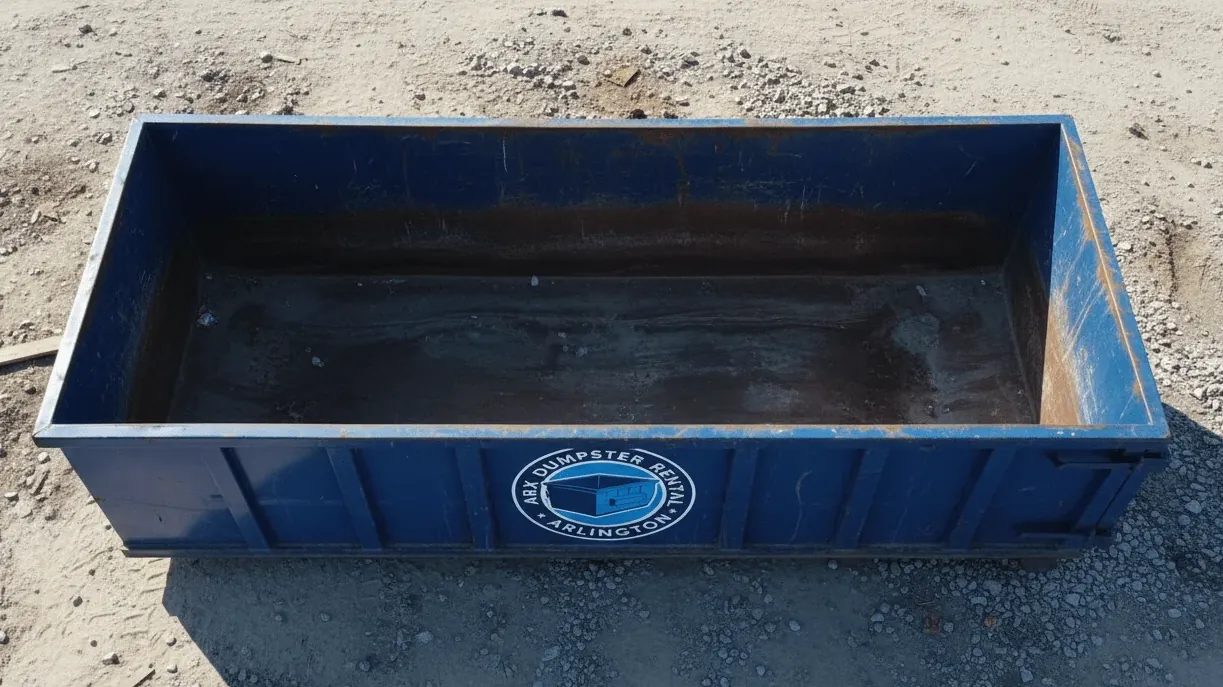
Two houses on the same Arlington street, put up the same year by the same builder, can spend forty years behaving completely differently. One has never moved. The other has a back door that drags every August and shuts fine again by November. The usual explanation offered is workmanship. The real explanation is what is underneath, and in Arlington that changes over a surprisingly short distance.
This is about that, and about what a foundation repair puts in a container when the crew is done. A pier job is the most misjudged load we quote: it sounds small on the phone and it is the heaviest thing we haul out of a residential driveway.
Arlington is not one soil, and that is the whole story
The lazy version of this page says Arlington sits on Blackland Prairie clay and stops there. That is half true, and anyone who has dug on both sides of town knows it. Tarrant County exposes fifteen surface geological formations, and they run in north–south bands. They outcrop oldest to the west and youngest to the east, so you cross them driving east or west and can stay on one for miles driving north or south.
Depending on where you stand, you are on one of these:
- Eagle Ford Group — dark bituminous shale that weathers down into the classic expansive clay. This is the problem unit, and it is what contractors mean when they say clay.
- Woodbine Formation — fine-grained sandstone with clay and shale through it. Sandier, more variable, less predictable hole to hole. The Arlington Archosaur Site, a significant Cretaceous fossil locality inside the city limits, sits in Woodbine rock.
- Austin Chalk — comparatively stable limestone along the eastern escarpment toward Grand Prairie. Arlington and Grand Prairie sit on the White Rock Escarpment, where the pale chalk rises over the dark Eagle Ford.
- Trinity River and Village Creek alluvium — clay, sand and gravel laid down by water through the north and centre of the city.
Soil conditions in Arlington change materially over a few miles, and that is exactly why foundation performance varies street to street. It is also why a neighbour's estimate tells you little about your own, and why pier depth on one job is nothing like pier depth three streets over.
How much the clay moves — USDA numbers, not adjectives
The dominant expansive soil here is Houston Black, the Texas state soil and a Vertisol — the soil order defined by shrinking and swelling. You do not have to take a contractor's word for how much it moves, because the USDA soil survey publishes figures.
| Property | USDA soil survey figure |
|---|---|
| Shrink-swell potential | High |
| Clay content | 40 to 60 percent |
| Crack width when dry | 0.5 to 4 inches |
| Crack depth | 12 inches or more |
| Days cracks stay open | 90 to 150 cumulative days a year |
Read that as one sentence: cracks four inches wide, a foot deep, open three to five months of the year. That is a federal soil survey description of ordinary ground in North Texas, not a sales line. A slab edge sitting on soil that does that is not a defect story. It is the design condition.
The annual cycle cracks slabs, not a single event
People look for the moment it happened: a storm, a leak, a drought summer. Usually there was no moment. The National Weather Service describes DFW precipitation as bimodal: wet spring, dry summer, wet autumn, dry winter. Layer on 20.2 days a year at or above 100°F, concentrated in July and August, and you have a pump that runs every year.
Through July and August the clay dries, loses volume and shrinks away from the slab perimeter, while the centre of the slab, shaded by the house, stays wetter than the edge. Autumn rain runs straight down the open cracks into soil that has been dry for weeks, and the perimeter swells and lifts. Then winter dries it back. Do that thirty or forty times and something gives — usually a corner, a doorway or a run of brick over an opening. The doors that stick in late summer and free up in November are not imagination.
How common this is — from the state's own regulator
Texas does not treat this as a fringe issue. The Texas Department of Licensing and Regulation's inspector bulletin IHB TB 10-01, citing ASCE and USGS, sets out the scale:
- Expansive soil damage affects 25 percent of all structures in the United States.
- It causes greater financial losses than earthquakes, floods, hurricanes and tornadoes.
- 60 percent of new homes are expected to see minor damage from it, and 10 percent significant damage.
- High soil moisture causes heaving; low soil moisture causes collapse and settlement.
What Arlington is built on top of that clay
Arlington's population was 7,692 in 1950 and 44,775 by 1960. Essentially the whole city was built from the mid-1950s on, and that is the slab era. Slab-on-grade dominates overwhelmingly, poured on grade beams, with the perimeter beam carrying load into soil that changes volume every year. Pier-and-beam appears only in the small pre-1950 core around downtown, Abram and Center; those houses can be re-levelled from underneath without breaking concrete, which changes what ends up in the container.
Basements are very rare across North Texas, and the reasons are worth stating. Expansive clay makes a below-grade wall a real engineering problem, because the soil that lifts a slab edge also pushes sideways. There is no frost-line requirement forcing a deep excavation, so unlike colder states you are not most of the way down already and a basement is pure added cost. And buyers here price on dollars per square foot. The market never built them.
What a foundation job actually puts in the box
Over three to eight days a residential slab repair produces four distinct waste streams, only one of which most people picture.
1. Excavation spoil — the heart of the problem
Every pier means a hole. On a perimeter job the crew digs at each pier location and often tunnels in under the beam to reach the bearing point, and everything that comes out has to go somewhere. That spoil is the same 40 to 60 percent clay, and by the time it reaches the container it has been wet down or has taken rain. Saturated Blackland clay is brutally heavy for its volume. It clings to the shovel and the box walls, and it uses up a truck's payload long before it fills the visible space.
A 10 yard box on a clay spoil job is at payload long before it looks full. Loaded past that, it does not leave the driveway and somebody hand-digs weight back out in the heat.
2. Broken concrete
Interior piers mean the slab gets opened. The crew saws an access hole at each one, sets the pier, and the concrete comes up in slabs with mesh or rebar through it. Exterior work adds broken grade beam, old porch slab and sometimes driveway — see concrete and heavy debris.
3. Landscaping, edging and flatwork removed for access
You cannot dig a perimeter pier through a flower bed, steel edging and a shrub row. All of it comes out first: shrubs, edging, decorative stone, sidewalk sections, patio slabs, sprinkler heads and the drip line cut on the way.
4. Interior finish debris where the repair triggers remediation
Lifting a slab back toward level is not cosmetically free. Drywall cracks reopen, tile laid over the old geometry cracks through, trim pulls away, and a bathroom over a repaired plumbing break gets gutted. Finish debris is often the largest volume, even though the clay is the largest weight.
| Job type | What actually comes out | Container that works |
|---|---|---|
| Perimeter piers, exterior only | Wet clay spoil, broken grade beam, edging and shrubs | 10 yard, flat and low |
| Interior piers through the slab | Broken slab with mesh and rebar, plus spoil | 10 yard, clean inert load |
| Pier-and-beam re-level, pre-1950 core | Sill and beam timber, old shims, some spoil | 15 yard, bulkier and lighter |
| Repair plus interior remediation | Drywall, trim, flooring, tile, cabinetry | 15 yard, separate from the clay |
| Driveway or patio tear-out | Broken flatwork, base and clay | 10 yard, concrete clean |
These are weight jobs, not volume jobs. Every instinct from a garage cleanout — biggest box, fill it to the rails, one haul — is wrong here, because a large box loaded with wet clay is an immovable object. Two small pulls beat one stranded 30 yard. The same logic runs through our 10 yard and 15 yard pages, the full range on dumpster sizes, and what size dumpster do I need in Arlington.
Loading rules for clay and concrete
- Spread it flat across the whole floor. No mound at the door end. An even layer keeps the load balanced and the box square on the rails.
- Never load above the rails. A heaped clay load cannot be tarped and will not leave.
- Keep concrete clean. On its own it is an inert load and gets separated at the landfill. Concrete with drywall and bagged trash through it is not.
- Let the clay dry if the schedule allows. A pile that sits two dry days weighs meaningfully less than the same pile out of a rained-on trench.
- Say the words foundation repair when you book. It changes which box we bring, and the driver arrives expecting weight.
Digging means Texas811, and it is a statute
Pier footings are excavation. So are a driveway tear-out, a fence line and a drainage trench added after the repair. All of it triggers notification, and the centre is Texas811.
- Notice no later than 48 hours before excavation and no earlier than the 14th day before, excluding Saturdays, Sundays and legal holidays — two working days.
- The governing law is the Texas Utilities Code, Chapter 251, the Underground Facility Damage Prevention and Safety Act.
- Penalties start at $500 for a first violation and escalate for repeats within a year.
Locators mark utility-owned lines. They do not mark your own irrigation main, low-voltage lighting or gas line to a pool heater, and on a pier job those sit in the first eighteen inches. Trace them before anyone digs, and if you are hiring the repair out, confirm the contractor filed the ticket.
Setting a loaded box on ground that also moves
The container sits on the same clay the crew is fixing.
- Protection boards go under every set, without exception.
- We need roughly 60 feet of straight approach, about 10.5 feet of width and 20 feet or more of clear overhead.
- The overhead obstruction here is almost always a tree. A mature post oak, live oak, cedar elm or pecan over the drive in a 1970s neighbourhood will stop a hoist arm the driveway itself would have handled. Look up before delivery day.
- If the box has to go in the street, a lane or traffic-flow impact brings city permitting into it. See Arlington dumpster permits.
Where the material goes
The Arlington Landfill at 800 Mosier Valley Road in Euless takes most of this. It is city-owned, operated under long-term lease by Republic, and it is one facility, not two, despite appearing online under a couple of names. Hours are Monday to Saturday, 7:00am to 4:30pm, closed Sunday. It accepts concrete and separates it out rather than burying it as mixed waste, which is why a concrete load is worth keeping clean.
One thing catches people out: the three free landfill drop-offs a year are homeowners only, tied to an Arlington Water Utilities account. Contractors get no free drop-offs and pay regular rates on every visit. That is part of why homeowners often handle the container themselves and hand the crew an empty box.
The kerb will not help. Construction debris is not collected kerbside in Arlington at any volume, and the weekly bulky allowance is around two cubic yards, which one pier job exceeds in an afternoon. Our page on construction debris disposal in Tarrant County covers the rest.
What to tell us when you call
Four things and we can size it on the phone: how many piers, interior or exterior or both, whether slab is being broken out, and whether interior finish work is part of the job. If there is already a spoil pile on the lawn, say how big and whether it has been rained on. Wet changes the answer. Larger remodels are covered under demolition debris and construction dumpster rental.
ARX Dumpster Rental has run roll-offs out of the yard at 1200 N Commercial Blvd in south Arlington since 2012. Andre Reyes started with one truck and four cans and still answers the phone. On a foundation job, expect him to talk you into a smaller box and more pulls. Call (817) 404-4864 or use our contact page.
Questions this guide did not answer? Call (817) 404-4864. We would rather spend two minutes on the phone than have you order the wrong container.