
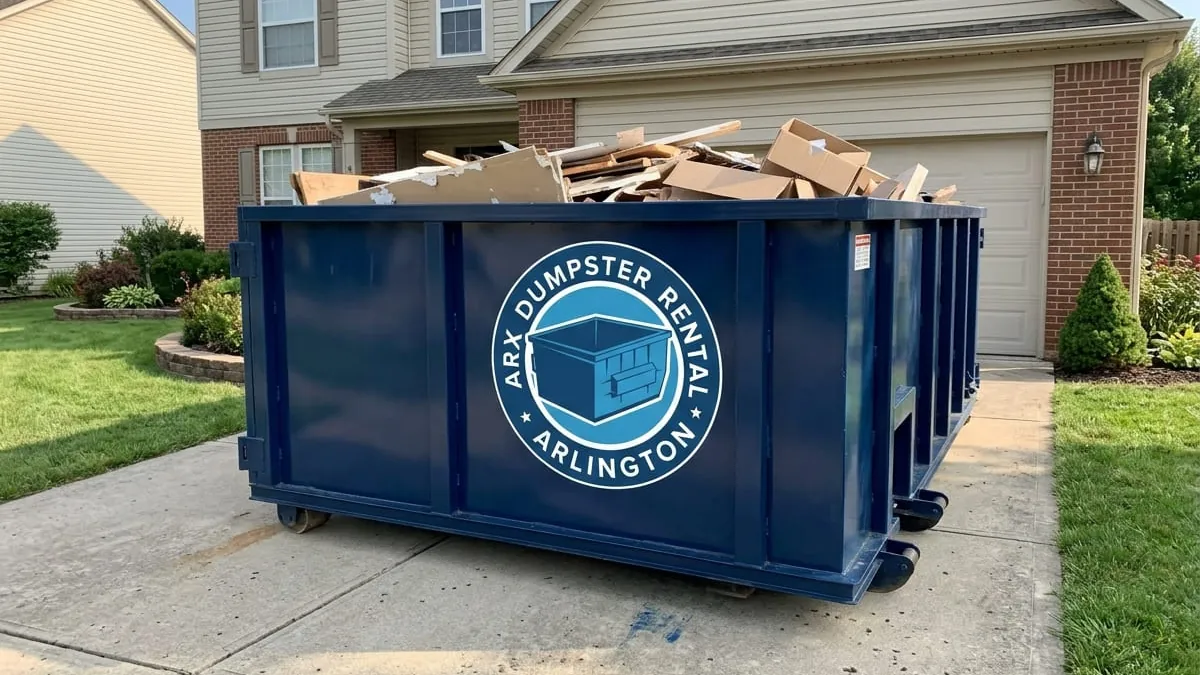
Arlington, TX · Tarrant County
Dumpster Rental in Arlington, TX — Delivered Fast, Priced Flat
10 through 40 yard roll-off dumpsters for homeowners, contractors and businesses across Arlington and the DFW Metroplex. One phone call, one flat price, and a driver who protects your driveway. Locally owned since 2012.
- Same-day & next-day delivery
- Flat rates that include disposal
- Driveway protection boards as standard
- Licensed, insured and locally owned
Licensed & insured · Flat-rate quotes · Locally owned since 2012
Why ARX Dumpster Rental
The dumpster company Arlington calls back
Most people renting a dumpster are already having a stressful week. The kitchen is in pieces, the roof is half off, or a family member has passed and there is a house full of forty years to sort out. The last thing anyone needs is a hauler who quotes one price, invoices another, and drops a container across the mailbox.
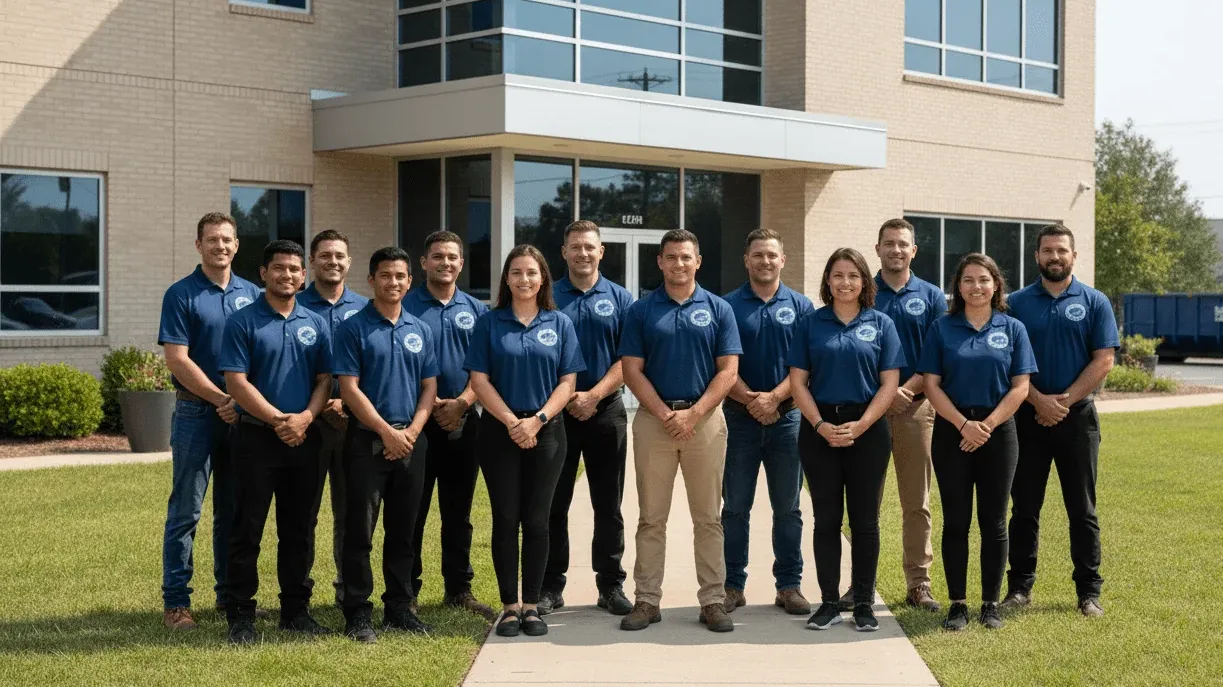
We started ARX Dumpster Rental in 2012 with one truck and one rule: tell people the truth about what it costs and show up when we said we would. 14 years later that has not changed. Andre Reyes still answers the phone most mornings, and our drivers still walk the drop before they back in.
We run out of 1200 N Commercial Blvd in south Arlington, off the I-20 corridor between Matlock Road and Collins Street, which is exactly why we cover Arlington, Tarrant County and the rest of the DFW Metroplex every single day rather than routing a truck in from the far side of the Metroplex when you need a container this afternoon. It also means we know the rulebooks apart: most of this is Tarrant County, but the real complication is city by city — Arlington, Grand Prairie, Mansfield, Kennedale, Fort Worth and Euless each run their own solid waste arrangements and their own permit desk; Pantego and Dalworthington Gardens are separate incorporated towns surrounded by Arlington, with their own permitting authority and their own disposal arrangements, which is why a Dalworthington Gardens resident needs a voucher and pays the published $47 at the Fort Worth Environmental Collection Center while an Arlington resident goes free; and the county line moves under you as well, with Grand Prairie mostly Dallas County and Burleson mostly Johnson. Past that it is street knowledge — which Woodland West, Fielder and Bowen streets have original single-car drives narrow enough, with a live oak or cedar elm limb over the whole approach, that a 30 has to sit on the street instead; which houses in the old downtown core off Abram and Center have barely a car width of drive, or none at all; which HOA neighbourhoods out through Viridian and the newer south Arlington subdivisions want the architectural committee notified in writing and hold you to whatever the declaration says about placement; which older blocks still work best off the back alley; which Rush Creek, Interlochen and Lynn Creek lots put a detached garage, a back patio or a shed right where the hoist arm wants to be; which drives are a gravel or dirt pad that turns soft for a day or two after a spring rain line; and which side of a UTA-area rental lot keeps the can clear of the low limbs and the service drop.
Read more about who we are and how we got started, or jump straight to what we haul.
- Founded2012
- Container sizes10 – 40 yd³
- Typical deliverySame or next day
- Towns served18+
What we haul
Dumpster rental services in Arlington and the DFW Metroplex
Eleven container services, one flat-rate promise. Whatever the job, the price we quote on the phone is the price on your invoice.
Residential Dumpster Rental
Driveway placement for garage, attic, shed and side-yard cleanouts and remodels.
Learn more →Commercial Dumpster Rental
Scheduled and on-call containers for retail, restaurants, offices and property managers.
Learn more →Construction Dumpster Rental
Jobsite roll-offs and next-day swap-outs for builders, remodelers and GCs.
Learn more →Roofing Dumpster Rental
Weight-rated cans sized by squares and layers for asphalt shingle tear-offs.
Learn more →Roll-Off Dumpster Rental
10, 15, 20, 30 and 40 yard roll-offs across Arlington and Tarrant County.
Learn more →Same-Day Dumpster Rental
Call before the cut-off and we can usually get a container to you this afternoon.
Learn more →Junk Removal Dumpsters
Clear a garage, attic, shed or side yard on your own schedule.
Learn more →Estate Cleanout Dumpsters
Discreet, patient container service for families clearing a lifelong home.
Learn more →Demolition Debris Removal
Containers and fast swaps for sheds, fencing, patio covers and interior gut-outs.
Learn more →Concrete & Heavy Debris
Dedicated heavy cans for broken concrete, brick, flatwork and wet clay spoil.
Learn more →Yard Waste & Brush Removal
Separate clean loads for storm limb wood the 2 cubic yard kerbside cap will not take.
Learn more →Choose your size
Five sizes, sized for real projects
Not sure which one? Tell us what you are clearing out and roughly how much of it there is. Ninety percent of the time we can size it correctly over the phone in under two minutes. The first question here is what the debris weighs rather than how much room it takes, because a load of wet clay spoil out of foundation pier holes, broken flatwork off a drive or patio, or an asphalt shingle tear-off counted in squares and layers is a weight job long before it is a volume job. Dense material like broken concrete, brick, block, pavers and excavation spoil wants a small can; a fence and deck tear-off, or a full gut of a two-storey out in Viridian or Rush Creek — framing lumber, cabinets, insulation and trim — is the job that genuinely wants a 40, because that debris takes up enormous space and weighs comparatively little. Bear in mind that an open can catches every spring rain line and the wind that comes with it, so keep the load below the rails where it can be tarped.
10 Yard Dumpster
Broken concrete, brick, flatwork, wet clay spoil and shingle — weight fills it long before volume does.
View this size → 15yd³15 Yard Dumpster
Single-room remodels, small tear-offs and rental turnovers near campus.
View this size → 20yd³20 Yard Dumpster
Garage, attic and shed clear-outs, multi-room renovations, deck and fence tear-offs.
View this size → 30yd³30 Yard Dumpster
Whole-property clears, new construction, additions and large remodels.
View this size → 40yd³40 Yard Dumpster
Bulky light debris only: fencing, patio covers, siding, insulation, furniture, fit-outs.
View this size →How it works
Four steps, no paperwork
- 1
Call us
Tell us the project, your address and when you want it. Two minutes on the phone and you have a flat price.
- 2
We deliver
Our driver walks the drop, lays protection boards and sets the container exactly where you want it.
- 3
You load it
Take your time within your rental window. Keep it level with the top rail and we handle the rest.
- 4
We haul it
Call or text when you are done. We pull it, sort what can be recovered and dispose of the rest properly.
Local knowledge
What makes hauling in Arlington different
Narrow drives, HOA letters and low post oak, live oak and cedar elm limbs
Placement is where most of the trouble starts here, and it is rarely about space. Arlington is a city of concrete and asphalt drives, but the ground under them moves. Through much of the city the soil is expansive clay that shrinks away from the slab perimeter through the July and August heat and swells again when the autumn rain returns, which is why kerbs sag, aprons drop a lip and a drive that looked flat in May has a step in it by October. Older drives, hairline-cracked flatwork and anything poured in the last month all get extra boards, and on a gravel or dirt pad we would rather wait a day after a spring rain line than cut ruts into it. In the older streets — the small pre-1950 core around Abram and Center, and the 1950s and 60s blocks near UTA — the original drives are barely a car wide and some houses have none at all, which turns the job into a street or alley placement. The gatekeeper most people underestimate is the HOA. Arlington’s large 1950s to 80s cohort largely predates the modern mandatory association, but the newer and master-planned parts of the city — Viridian in the north, the newer south Arlington subdivisions — are covenanted, and it is the declaration and the architectural guidelines that govern placement, not any state statute. Texas Property Code Chapter 202 protects solar panels, flags and hail-resistant shingles, but it says nothing about containers, so get the letter before we roll rather than after. Then the overheads: low post oak, live oak and cedar elm limbs are the number one obstruction here, with pecan, hackberry and Bradford pear behind them, and then the service drop. Figure on roughly 60 ft of straight approach, 10.5 ft of width and 20+ ft of clear sky for the hoist arm. On permits, be careful what you read elsewhere: there is no dumpster-specific permit anywhere in Arlington’s code, and there is no ordinance capping how many days a container may sit and no screening requirement either. What does apply is the general obstruction prohibition in Streets and Sidewalks §6.01, and, if a lane or traffic flow is affected, a Temporary Traffic Control Permit from Arlington Public Works — allow a minimum of three business days, work to the Texas MUTCD, and note the city publishes a $500 a day fine for non-compliance. Construction in the right-of-way itself goes through the Public Right-of-Way Permit from the Right-of-Way Division on (817) 459-6634, and work in state right-of-way, such as a frontage road along I-20 or SH-360, needs TxDOT approval before the city’s. The real exposure on a container that sits for weeks is code enforcement rather than a dumpster rule: nuisance ordinance §2.02(M) treats discarded building materials as a nuisance, but expressly exempts materials stored in a workmanlike manner in conjunction with an active building permit — pulling the permit is itself the defence. Call Texas811 two working days before anything gets dug, which on a pier job, a fence line or a drive tear-out is most of them. Tell us the cross streets and we will tell you where the can goes, or see the permit and placement guide.
Slab-on-grade, and the weight that comes with it
Houses in Tarrant County sit on slab-on-grade, and the story here is not what is under the floor but what the ground does to it. Arlington counted 7,692 people in 1950 and 44,775 by 1960, so very nearly the whole city was built from the mid-1950s onward, which is the slab era. Pier-and-beam survives only in the small pre-1950 core around downtown, and basements are very rare across North Texas for three plain reasons: expansive clay makes a below-grade wall an engineering problem rather than a footing detail, there is no frost line deep enough to force the excavation anyway so a basement is pure added cost, and buyers here price on dollars per square foot. Underneath, the soil is not uniform either. Arlington sits across north–south bands of Eagle Ford shale, Woodbine sand and clay, Austin Chalk and Trinity and Village Creek alluvium, which is exactly why foundation performance varies street to street rather than neighbourhood to neighbourhood. Where the Houston Black clay dominates, the USDA soil survey puts clay content at 40 to 60 percent and records cracks half an inch to four inches wide and a foot or more deep, open 90 to 150 days a year. That annual shrink and swell, not any single storm, is what cracks slabs here. Sizing guides written for northern markets assume a whole extra floor of stored contents and get Tarrant County jobs wrong from the first question: a cleanout here comes out of the garage, the attic, the shed, the side yard and the back patio, plus whatever storage unit somebody has been paying for since the last move — and the attic is an early-morning job in July and August, when the average high sits at 95.6°F and 95.8°F and the heat has already ruined the tape, vinyl, photographs and adhesive stored up there. What this market produces instead of a wet lower floor is weight, and it arrives in three forms. Wet clay excavation spoil off pier holes and perimeter tunnelling is very heavy for its volume and is a genuine payload problem on a roll-off. Broken concrete and flatwork — slab breakouts, interior pier access holes, drives, aprons and patios — is the same conversation. And an asphalt shingle tear-off is sized by squares and layers rather than by roof area, and it is dense. When in doubt about sizing in Arlington, the answer is a smaller box because of weight, not a bigger box because of volume. Pre-1980 buildings turn up asbestos in floor tile and black mastic, pipe and duct wrap, textured ceilings and roofing felt, and pre-1978 homes carry lead paint under the EPA RRP rule. In Texas the asbestos notification goes to DSHS, the state health agency, not TCEQ — that is the single most commonly botched fact about demolition in this state. Notification is due at least 10 working days ahead and is required before demolition even when no asbestos is present, though 25 TAC §296.1(c) exempts a single private residence or an apartment building of no more than four units. Add the Arlington scheduling trap on top: a building 50 years or older, or of undetermined age, goes to the Landmark Preservation Commission, which cannot deny a demolition permit but can extend a historic stay by 45 days, and that trigger now catches everything built through roughly 1976. And we cannot take asbestos-containing material in any container. See what we can and cannot take in the Tarrant County debris guide and our notes on pier spoil and concrete debris, and confirm current requirements with the agency before you start.
Hail sets the calendar and clay, concrete and shingle set the weight
The seasonal driver here is spring. In the National Weather Service Fort Worth area, April has produced 555 tornadoes since 1950 and May 525 — about seven each a year, and together roughly 55 percent of the annual total — with a genuine secondary peak in October, at 145, that most writers miss. The hail window runs March through June, and hail is the commercial engine of this market: Texas leads the nation for hail, with 902 hail events in 2025 and more than 235,000 Texas homes damaged, and DFW sits in the highest-risk tier. One line of storms can put a subdivision of tear-offs on the books inside a week, which is why insurance work and roofing schedules drive our spring. Wind and water are two different jobs with two different debris streams: water means saturated drywall, insulation, flooring and contents out fast and heavy, while wind and hail mean shingles, decking, fascia, fence panels and tree work. Downed limb wood here is post oak, live oak, red oak, cedar elm, pecan, bur oak, hackberry, bois d’arc and Bradford pear, and green hardwood is far heavier than it looks — a load of oak limb wood will sit at payload in a box that still looks half empty. On the roof itself it is weight rather than volume, and it is sized by squares and layers, not roof area; out here the layers question is usually whether a 1970s or 80s house is on its second or third composition roof with the original still underneath. Pre-1980 roofing felt is a stop-and-test moment. Metal patio covers and shop roofs come off in long light sheets that need holding down in an open can and are worth pulling as scrap rather than burying. Summer heat is the operational constraint rather than a storm season — July averages a 95.6°F high and August 95.8°F, with 20.2 days a year at or above 100°F, the first usually around 1 July and the last around 27 August — so attic work and tear-offs move to the early morning through those weeks. Winter is a short-duration ice and hard-freeze problem, not a snow problem: 29.2 nights a year at or below freezing, and when it goes wrong it goes wrong hard. February 2021 took DFW to −2°F with 139 consecutive hours below freezing and 5.0 inches of snow, and the late January 2023 event dropped 1.3 inches of sleet at DFW with 88 straight hours at or below freezing. That kind of week disrupts delivery for days rather than months, and it leaves burst-pipe repairs, split trees and gutter work behind it. Get the material, the layer count and the square count before you order — see roofing dumpsters, the tear-off sizing guide and our notes on hail and storm damage cleanup. Watch the National Weather Service through the spring for hail-capable cells.
Weight at one end, the kerbside cap at the other
Broken concrete, brick, block, pavers and wet clay spoil all run around 2,400–2,800 lbs per cubic yard, so a heavy load reaches legal transport weight in a container that still looks half empty. That material belongs in a 10 yard, twice, not a 30 once — see concrete and heavy debris. The local versions of it are excavation spoil off a foundation pier job, a drive or apron broken out, a patio lifted with its footings, a brick or block wall coming down, and the flatwork removed to get at a slab perimeter. The other half of this job is not dust, it is the kerb. The City of Arlington moved to 95-gallon automated carts in February 2024, with a 65-gallon cart on request, extra carts at the city’s published $6.89 a month, and one single collection day for trash, recycling, yard waste and bulky items. Carts left in public view earn an orange “Oops” tag and eventually a citation the city sets at a $37 minimum. Brush must be cut to 4-foot lengths, no more than 6 inches in diameter, in bundles under 50 pounds, and bundled brush, yard waste and bagged leaves together are capped at roughly 2 cubic yards a household a week. Bulky items are weekly and included, and capped at 2 cubic yards as well. Then the sentence the whole roll-off market in this city rests on: the city states plainly that construction debris and roofing shingles cannot be collected curbside and that contractors are responsible for hauling those materials away. One re-roof produces many times 2 cubic yards, and the kerb will not take it at any volume. On the green side, get this right: Texas has no landfill ban on yard waste — 30 TAC §330.15 does not list it, and the city itself says bagged leaves picked up at the kerb are not recyclable and go straight to the landfill. We still run vegetative debris as a clean separate load, by choice and for cost, because the Arlington Landfill turns green waste into mulch. What Texas does keep out of disposal is lead-acid batteries, do-it-yourself motor oil, used oil filters, whole unprocessed tires and bulk liquid waste, and appliances are a federal matter: refrigerant has to be recovered by a certified technician before the unit goes anywhere. So we load heavy over light, keep everything below the top rail where it can be tarped and will not blow out in a gust front, bag the insulation and break the cardboard down. See yard waste removal and the Arlington recycling and disposal guide.
- 14+Years serving Tarrant County
- 18Towns in our service area
- 13In-depth local guides published
- 5Container sizes, 10 to 40 yard
What customers say
Straight talk from Arlington and the DFW Metroplex
Andre was the only one who asked what was going in it before he quoted. Pier spoil off a foundation job, and he swapped us down to a 10 because wet clay would have been over the scale in anything bigger. He was right — it came out just under.
Three layers of shingle on a 1968 roof and a hail claim on the clock. They had a can on the drive at seven in the morning, on boards, and their driver moved it twice so the crew could work the back slope. He also warned me the low pecan limb would not clear the arm.
We turn eleven units near campus every May and August, which is the worst possible fortnight to need anything in this town. ARX is the only outfit that has never left us waiting with a make-ready half torn apart.
My father had been in the same house off Bardin Road since 1979 and we had a month to clear it before the listing. They set a 20 on boards and swapped it twice, and never once made us feel rushed. The driver flagged the paint and the old chest freezer for their own routes rather than letting us bin them.
Reviews are shown as supplied by customers. Ratings and counts shown elsewhere on this site are illustrative pending live review syndication.
Service area
Dumpster delivery across Tarrant County and the DFW Metroplex
We deliver daily from our Arlington yard. Pick your city for local placement notes, landmarks and permit guidance — or see the full service area.
Dumpster Rental FAQs
How fast can you deliver a dumpster in Arlington?
Most of the time, same day if you call before about 11am, and next morning otherwise. We run our own trucks out of 1200 N Commercial Blvd in Arlington, so we are not waiting on a dispatcher on the far side of the Metroplex. In the week after a spring hail line comes through, when every roofer and tree crew in the DFW Metroplex is booked solid, it can stretch to 48 hours, and we will tell you honestly when you call. The other predictable rush is the university calendar — the UTA move-out window in May and the rental turnover that follows it through the blocks around campus — along with event days in the Entertainment District when the streets around the stadiums close. If you know your dates, book ahead and we will hold the slot.
What does a flat rate actually include?
Delivery, pickup, an agreed rental period and a set tonnage allowance with disposal included. No fuel surcharge, no environmental fee, no admin fee. The only way the number changes is if you go over the weight allowance or keep the container longer than agreed, and we tell you both limits before we deliver.
Do I need to be home for delivery or pickup?
No. Plenty of our customers text us a photo of where they want it and go to work. All we need is clear access, a spot free of cars and low branches, and permission to be on the property. If the only way in is a narrow drive, a back alley, a gate beside a detached garage or a shed, or a gravel or dirt pad still soft after a spring rain line, tell us when you book and we will schedule accordingly. If the house is in an HOA neighbourhood, say so on the first call — the declaration and the architectural guidelines are what govern placement here, no state statute overrides them, and it is easier to square away before we roll than after. Mention low post oak, live oak and cedar elm limbs, patio covers and the service drop as well, because the hoist arm needs the height. Say so if the house is empty, too — on an unattended job the wind is the risk, so we will talk you through keeping the load below the rails where it can be tarped, and we will time the pull so a loaded can is not sitting open through a spring storm week.
Will the dumpster damage my driveway?
We put protection boards under the wheels and rails on every residential delivery, which spreads the load instead of concentrating it on four small contact patches. The complication here is the ground rather than the concrete: the expansive clay under much of {ADDR_CITY} shrinks back through the July and August heat and swells again with the autumn rain, so drives crack, aprons drop a lip and older flatwork has usually moved before we ever arrive. We photograph the existing condition on delivery either way. Narrow drives, alley approaches and older or hairline-cracked concrete get extra boards, and so do the newer subdivision drives through Viridian and south {ADDR_CITY}, which settle under a point load rather than scuff. On a gravel or dirt pad we are fine while it is dry, but for a day or two after a spring rain line we would rather come back than cut ruts into it. Our placement guide explains it fully.
Do I need a permit for a dumpster in Arlington?
On your own driveway, no permit has been identified — the city’s own homeowner permit guide lists roofing, solar and fences and does not mention containers at all. More usefully: there is no dumpster-specific permit anywhere in Arlington’s code, whatever a national site tells you, and there is no ordinance limiting how many days a container may sit and no screening requirement either. What applies if the container goes in a public street, alley or right-of-way is the general obstruction prohibition in Streets and Sidewalks §6.01, and, where a lane or traffic flow is affected, a Temporary Traffic Control Permit from Arlington Public Works — allow a minimum of three business days, work to the Texas MUTCD, and note the city publishes a $500 a day fine for non-compliance. Construction in the right-of-way goes through the Public Right-of-Way Permit from the Right-of-Way Division on (817) 459-6634. Anything touching state right-of-way, such as a frontage road along I-20 or SH-360, needs TxDOT approval before the city’s. Grand Prairie, Mansfield, Kennedale, Fort Worth and Euless each run their own right-of-way desk, and Pantego and Dalworthington Gardens are separate incorporated towns sitting inside the Arlington street grid with their own permitting authority, so the rulebook can change a few streets apart. The exposure people actually forget on a long job is code enforcement rather than a dumpster rule: nuisance ordinance §2.02(M) makes discarded building materials a nuisance but exempts materials stored in a workmanlike manner under an active building permit, so pulling the permit is itself the defence. The other approval people forget is the private one: on HOA property the declaration and architectural guidelines govern placement, and Texas Property Code Chapter 202 gives you no right to place a container over the association’s objection. Call Texas811 two working days before anything gets dug. Requirements change, so confirm with the city and your HOA before you book — or read our permit and placement guide.
What can I not put in the dumpster?
Wet paint, solvents, motor oil, fuel, pesticides, automotive chemicals, asbestos-containing material, propane and other pressurised cylinders, lead-acid batteries, medical waste, whole tires and refrigerant appliances. Leftover paint, solvents, fuel, pesticides and pool chemicals go to the Fort Worth Environmental Collection Center at 6400 Bridge Street rather than in the can — Thursday and Friday 11am to 7pm, Saturday 9am to 3pm, free to Arlington residents with no voucher, once a month, and residential only, so a contractor with leftovers from an Arlington job cannot use it. Note that PaintCare does not operate in Texas, whatever a national guide says: latex paint can be dried out and put in the regular trash, and oil-based paint goes to the collection centre. Texas has no landfill ban on yard waste either, so ignore that one too — what actually stops you at the kerb is the city’s roughly 2 cubic yard weekly cap on brush and yard waste, the 4-foot, 6-inch, 50-pound bundle rules, and the flat statement that construction debris and roofing shingles are not collected curbside at all. Green waste still travels best as its own clean separate load bound for composting or mulching rather than mixed into a construction load. Statute does keep whole unprocessed tires, lead-acid batteries, used motor oil, used oil filters and bulk liquids out of landfill disposal, and appliances need their refrigerant recovered by a certified technician first under federal rules. Everything else on a normal cleanout or renovation is fine. Rules do change, so ask us before it goes in.
Still not sure?
Two minutes on the phone beats twenty minutes reading. Tell us the job and we will size it, price it and book it.
(817) 404-4864Helpful Local Resources
Useful official sources for permits, disposal rules and recycling in Arlington and Tarrant County. We keep these handy because half the questions we get are really questions for one of these offices.
- City of ArlingtonKerbside collection limits, bulky and brush allowances, the landfill drop-off programme, demolition and traffic-control permits.
- TCEQTexas municipal solid waste rules, the 30 TAC §330.15 landfill prohibitions and the composting and mulching pathway.
- Texas DSHSAsbestos demolition and renovation notification for Texas — ten working days, and required even when no asbestos is present.
- Texas811Free utility locates before you dig, demolish or excavate — two working days’ notice under Utilities Code Chapter 251.
- TxDOTApproval for work or containers affecting a state right-of-way such as an I-20, I-30, SH-360 or US-287 frontage road.
- Tarrant CountyCounty information and the roster of incorporated cities, including the Pantego and Dalworthington Gardens enclaves.
- Fort Worth ECCThe Environmental Collection Center on Bridge Street — free household hazardous waste drop-off for Arlington residents.
- National Weather ServiceSevere weather outlooks, hail and tornado climatology and winter storm guidance for the DFW Metroplex.
Talk to a real person
Need a dumpster in Arlington today?
Tell us what you are clearing out and we will tell you the right size and the flat price to put it in your driveway. No forms, no waiting on an email — just call and we will sort it out in a couple of minutes.
Serving Arlington, Tarrant County and the DFW Metroplex · Mon–Fri 6am–5:30pm, Sat 7am–2pm